worth it or not uppermore without paid software is the kind of search people make when they are standing between two choices: keep using a free option or finally pay for the features they need.
There is a practical reason this question matters. Software subscriptions can add up quickly, especially when you already use separate tools for documents, design, AI, storage, communication and productivity. A free plan may appear sufficient at first, but a single missing feature can eventually become a daily inconvenience.
There is also an important complication with the name “Uppermore.” It is not clear from the available information that this refers to one established software product with a reliably documented free and paid feature set. That means inventing a detailed pricing or feature comparison would be misleading.
A better approach is to treat the question as a free-versus-paid software decision: identify what the product actually is, verify the official offering, and then decide whether paying solves a problem you genuinely have.
Worth It or Not Uppermore Without Paid Software?
If you have found a product or service called Uppermore and are wondering whether you can use it without paying, start with the official product information rather than third-party download pages or comparison posts.
Check the exact product name, developer, official website, current pricing, supported platforms and description of the free plan. Software names are sometimes misspelled, reused, or confused with similarly named services. A comparison is only useful when you know you are comparing the correct product.
This verification step becomes especially important when a search result promises a “free premium version.” A legitimate free tier is very different from a modified installer, cracked application or unofficial copy claiming to unlock paid functionality.
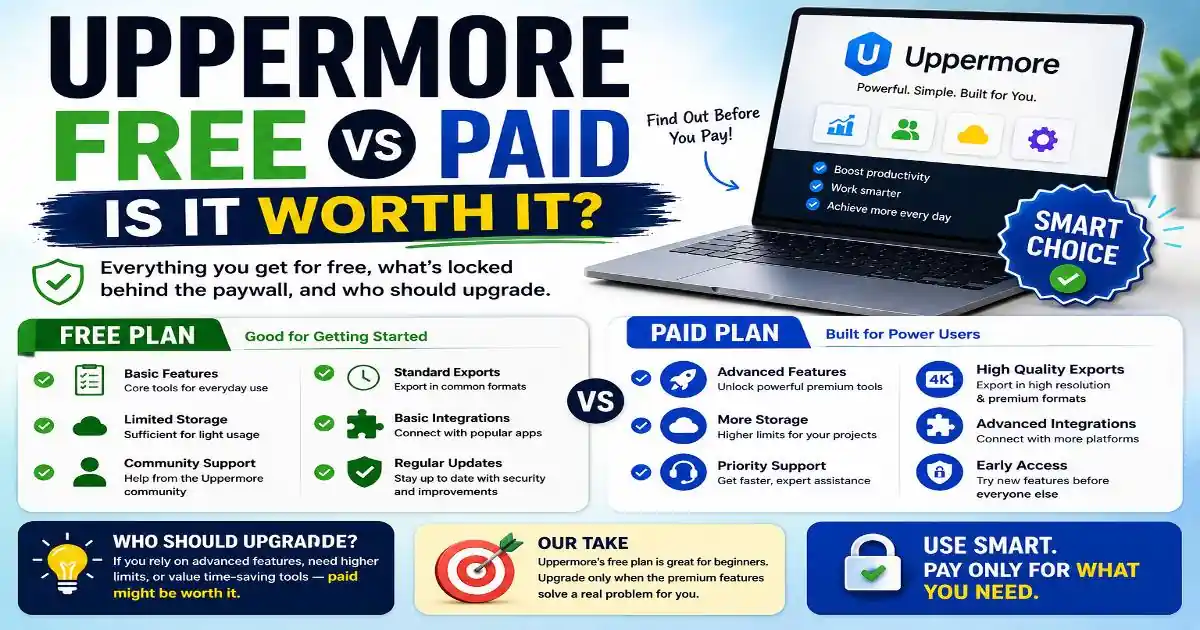
What You Usually Get From Free Software
Free plans are often designed to make the core product useful enough that people can understand its value before upgrading. That can be perfectly adequate for casual users.
A free version may provide the basic workflow, limited storage, a restricted number of projects, standard exports, fewer integrations, or access to a smaller selection of tools. The exact limits vary between products, which is why users should check the current official plan information instead of assuming that every free tier works the same way.
For someone who uses software occasionally, these restrictions may barely matter. If you only need the application once or twice a month, paying for advanced capabilities that you rarely touch may not make financial sense.
The free option becomes particularly attractive when the core task works without watermarks, forced advertisements, severe export restrictions or other limitations that interfere with your actual workflow.
When the Paid Version Starts Making Sense
The argument for paying becomes stronger when a premium feature solves a repeated problem.
Imagine a user who regularly reaches a project limit, needs a particular export format, requires more cloud storage, depends on advanced collaboration, or needs a feature that is deliberately restricted to paying customers. If that limitation appears every week, the subscription may be less about buying extra features and more about removing friction.
That distinction is important.
A premium plan is easier to justify when it saves meaningful time or enables work that the free plan cannot support. It is much harder to justify when the main attraction is simply having access to a longer feature list.
Users should also consider whether the software is part of professional work. A freelancer or small business may recover a monthly subscription quickly if the tool saves several hours of repetitive work. A casual user may get little additional value.
Free vs Paid: What Should You Actually Compare?
Instead of comparing every feature on a pricing page, focus on the capabilities that affect your own work.
Core functionality: Can the free version complete the task you originally installed the software for? If yes, there may be no immediate reason to upgrade.
Usage limits: Check whether the free plan limits projects, exports, storage, processing, collaborators, or monthly activity. A generous limit today can become restrictive as your usage grows.
File and export options: A tool can appear fully functional until you discover that the format you need is restricted to premium users. For creators and business users, export limitations can be more important than the number of available features.
Integrations: Free users may not receive access to certain third-party services, APIs, automation features or collaboration integrations. If your workflow depends on connecting several applications, this can become a deciding factor.
Support: Paid plans sometimes provide faster support or additional administrative controls. That may matter more to a business than to an individual user.
Privacy and account controls: Before uploading sensitive documents or business information, understand how the service handles data and what account controls are available. Price should never be the only consideration when confidential information is involved.
Do You Really Need a Premium Software Subscription?
A useful test is to keep using the free version until you encounter a limitation that directly affects your work.
Do not upgrade simply because the premium page lists dozens of additional capabilities. Instead, ask what problem the subscription would solve.
If the answer is “I need this one feature every day,” the upgrade may be worthwhile. If the answer is “the premium version looks more professional,” wait and test the free workflow longer.
This approach also prevents subscription creep. A person can easily accumulate several inexpensive plans and eventually spend more than expected on software that is only occasionally used.
Be Careful With Free Alternatives and Unofficial Versions
When people decide that paid software is too expensive, the next search is often for an unlocked or modified version. This is where cost-saving can turn into a security problem.
Unofficial installers can contain malware, spyware, unwanted browser extensions or other modifications. A file claiming to provide premium functionality for free should therefore be treated differently from a legitimate free tier offered by the developer.
For software you intend to use regularly, download from the official website, recognized app store or trusted software repository. Keep the application updated and avoid disabling security protections simply to make an unofficial version run.
This matters even more when the software handles passwords, documents, customer information, payment details or cloud accounts.
A Better Way to Decide Whether Uppermore Is Worth Paying For
If Uppermore is the name of a specific product you are evaluating, first confirm the exact developer and current official pricing. Then identify the one or two features that are making you consider the paid version.
If those features are unnecessary, stay with the free option. If they remove a recurring limitation, calculate the cost against the time or capability you gain.
For example, paying a small monthly amount can make sense when a tool removes hours of repetitive work each month. It may not make sense when the same result can be achieved comfortably with a free application and a simple workflow.
Also consider alternatives. Sometimes the right answer is not “free versus premium.” It is choosing another application whose free plan already includes the functionality you need.
That is especially common in categories such as AI tools, image editing, productivity applications, developer utilities and cloud software. Competition means users often have several ways to solve the same problem.
The safest conclusion is therefore straightforward: do not pay for Uppermore or any unfamiliar software until you have verified exactly what the product is, what its free plan provides, and which paid feature you actually need.
A free plan is valuable when it completes the job. A paid plan is valuable when it removes a meaningful limitation. The better choice is whichever one fits your real workflow rather than whichever one has the longer feature list.
Official References & Citations
- "Uppermore Worth It Without Paid Software? Free vs Paid Intelligence Briefing" — Softech Alert Security Intelligence
- "Cyber Threat & Scam Analysis Report" — Digital Defense Portal
- "Consumer Advisory on Web & Mobile Threats" — Security Guidelines