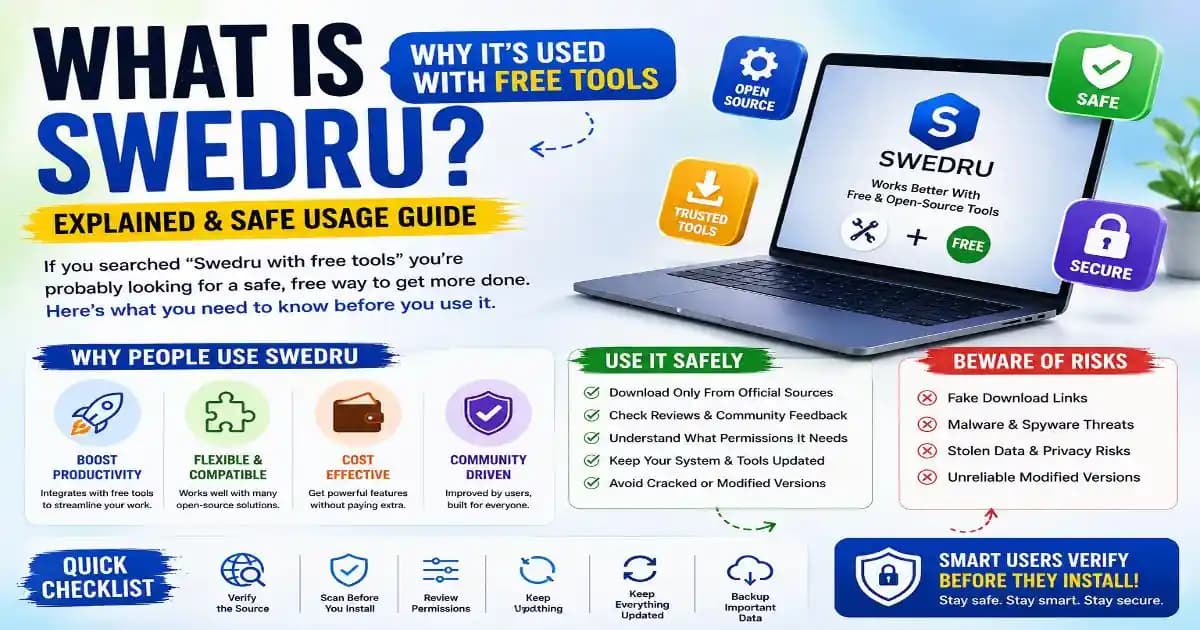
Why is Swedru used with free tools is a difficult search question to answer confidently because “Swedru” does not appear to identify a clearly established software product or open-source package in the results that can be reliably verified.
That matters more than it might seem. When people search for an unfamiliar technology name alongside phrases such as “free tools,” “download,” or “alternative,” they may be trying to understand a legitimate software integration, a community-developed project, a local platform, or simply a term that has been misspelled or confused with another product.
Search results for “Swedru” also commonly refer to Agona Swedru in Ghana rather than a technology product, which makes it unsafe to invent a software explanation that cannot be independently verified. ([Tech Dream Africa][1])
So the useful answer is not to pretend that a particular Swedru application has known capabilities. Instead, users should understand how to verify an unfamiliar software name and safely combine legitimate free or open-source tools with it when the actual product has been identified.
Why Is Swedru Used With Free Tools?
If you encountered the phrase “Swedru with free tools” in a download page, social post, tutorial, video, forum or search result, the first step should be identifying exactly what “Swedru” means in that context.
Software names are frequently shortened, misspelled or copied between websites. A product may also have a project name, package name and commercial name that are different from each other. Searching only one spelling can therefore produce misleading results.
This is particularly important when a page promises that an unfamiliar application works with several “free tools.” The phrase may describe a legitimate workflow, but it can also be used as marketing language around unofficial downloads.
A trustworthy explanation should identify the developer, official website, supported operating systems, documentation and licensing information before recommending an installation.
Why Free Tools Can Be Useful
Free software is not automatically inferior or unsafe. Some of the most widely used developer, productivity, security and creative tools have free tiers or open-source editions.
Open-source software can be especially useful because its source code is available for inspection and can be reviewed, modified and redistributed according to its license. That does not mean every open-source project is automatically secure. A poorly maintained project can still contain vulnerabilities, and an unofficial download can be modified even when the original project is trustworthy.
The distinction between free and trustworthy is therefore important.
A legitimate free tool should still have a recognizable source, documentation, version history and a sensible distribution method. Users should also be able to determine what permissions or access the software requires.
How to Verify an Unfamiliar Software Name
Before installing anything described as “Swedru,” begin with the identity of the software rather than its promised features.
- Find the original developer. Look for an official project page, company website or recognized developer account. Avoid treating a download mirror as proof that the software is legitimate.
- Check the documentation. A genuine technical project normally explains what it does, which platforms it supports and how it should be installed.
- Compare the name. Check spelling, capitalization and package names. A small difference can lead you to a completely different application.
- Review the license. For open-source software, look for a recognizable license and a repository or project page where the licensing terms are clearly explained.
- Inspect the download source. Prefer official repositories, official app stores or the developer's own distribution channel. Avoid modified installers and suspicious “premium unlocked” packages.
This process may take a few minutes, but it is much safer than installing an unknown executable simply because a website claims it is free.
How Malware Gets Hidden Behind “Free Software”
Cybercriminals understand that people actively search for ways to avoid subscription costs. That makes “free alternative,” “cracked version,” and “full version free” searches attractive targets for malicious downloads.
A fake installer can appear to provide the requested software while secretly installing another program. Some malicious applications attempt to steal browser cookies, passwords, cryptocurrency credentials or personal files. Others may display unwanted advertisements or use the device's resources for unauthorized activity.
The danger is not limited to obvious malware. A modified application can also contain unnecessary tracking components or request permissions that have little relationship to its stated purpose.
This is why software security should begin before installation rather than after something goes wrong.
Can Free and Open-Source Tools Be Combined Safely?
Yes, provided the individual components are legitimate and their roles are understood.
For example, a developer might combine an open-source command-line utility with a free code editor. A creator might use a free image editor alongside a browser-based conversion tool. A business user might combine free cloud storage features with an open-source document utility.
The fact that multiple tools are involved does not automatically create a security problem. The risk comes from what each application can access and where it came from.
Pay attention to permissions, network access, file-system access and browser extensions. A simple utility that needs access to every personal file or browser session deserves more scrutiny than one that performs a narrow function with limited permissions.
What to Do If You Already Installed an Unknown Tool
If you have already downloaded something associated with the “Swedru” search and are now uncertain about it, do not immediately assume that your device has been compromised.
First, identify the installed application's exact name, publisher and version. Check where it came from and compare it with the developer's official documentation if available.
Then review the application's permissions and behavior. Unexpected browser extensions, new startup programs, unusual pop-ups, unexplained network activity or sudden performance changes deserve investigation.
On Windows, Microsoft Defender and other reputable security products can help scan suspicious files. On Android, users should prefer Google Play and review the application's permissions. On macOS, Windows and Linux, software should ideally come from trusted repositories or the developer's official distribution channel.
If you entered a password into an unfamiliar application or website, change that password from a trusted device and enable stronger authentication where available.
Why Software Identity Matters More Than a “Free” Label
The biggest lesson behind this search term is that software should be evaluated by provenance, purpose and behavior rather than price.
A free application from a reputable developer can be safer and more useful than an expensive application downloaded from an unknown source. Conversely, a free download promising features that normally require payment can be a warning sign when it comes from an unofficial website.
The same principle applies to AI tools, browser extensions, developer utilities, productivity applications and cloud software. Users should know who created the tool, what it does, what access it receives and where updates come from.
When a technology name is unclear, slowing down is often the smartest move. Verify the identity first, then investigate compatibility and security, and only afterward decide whether the tool belongs in your workflow.
In the case of the phrase “why is Swedru used with free tools,” there is not enough reliable evidence to claim that Swedru is a specific software package. That uncertainty itself is useful information: it tells users not to download something simply because a search result connects the name with free software.
A few minutes spent verifying the product can prevent much more expensive problems later.