What Happened in the Bristol Schools Cyber Attack?
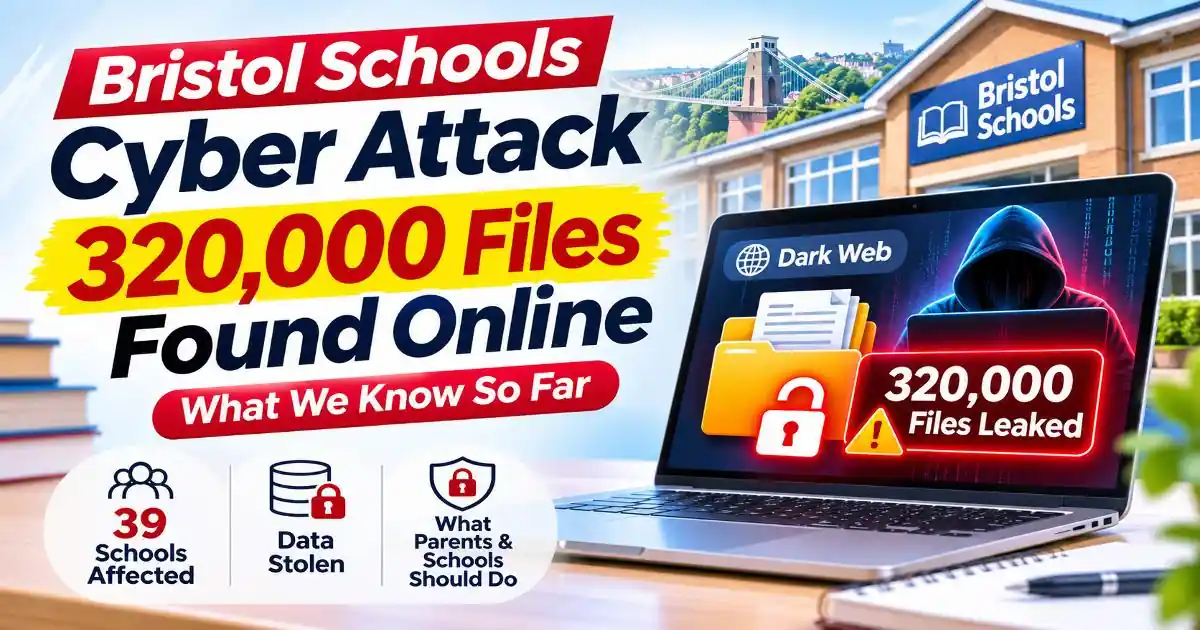
The Bristol schools cyber attack has raised serious questions about the security of educational records after more than 320,000 files stolen from a council-linked school system were reportedly found published on the dark web. The discovery represents a significant development in an incident that began in September 2026 and disrupted IT services across schools in Bristol, England.
Bristol City Council has said that investigators are reviewing a large volume of published material to establish what information was exposed and which schools or individuals may be affected. Headteachers at affected schools have been informed and are sharing guidance with families. The council has also advised people to remain cautious about unexpected messages, emails and phone calls.
There is an important distinction between the number of files and the number of people affected. The reported figure of more than 320,000 refers to files, not confirmed victims. Authorities have not yet established publicly that every file contains personal information, or confirmed the complete nature of the material.
How Did the Bristol Schools Cyber Attack Develop?
The incident involved Trading with Schools, a platform operated by Bristol City Council and used by schools for a range of administrative and operational services. The system was affected by malicious software in September 2026. Suspicious activity was first identified on 21 September, and the council subsequently disconnected affected schools from the internet as a containment measure.
At the time, the immediate priority was to limit the spread of the threat and protect connected school systems. The disruption affected internet access at schools using the council's education IT services. Schools had to adjust their operations while technical teams investigated the incident and worked towards restoring connectivity.
Earlier reporting described the platform as being used for activities such as scheduling, lesson planning, school budgets, staff records and payroll information. Some systems connected with school administration can also hold sensitive pupil-related material, including educational psychology records. However, the presence of these data categories in a system does not establish that every category was stolen in this incident.
On 4 November 2026, reports said that more than 320,000 files associated with the attack had been found published online. The council's investigation was still examining the material, so the exact information involved and the people affected had not been fully confirmed at the time of writing.
What Is Trading with Schools and Why Does It Matter?
Trading with Schools is a Bristol City Council service that supports schools with administrative and technology-related services. The platform and associated services are used by educational settings for parts of their everyday operations. This can include access to systems that support planning, staff administration, financial processes and other school functions.
When multiple schools depend on a shared service, a security incident involving that service can have consequences beyond one individual institution. A weakness in a central system, a compromised account or malicious software can potentially affect multiple connected organisations, depending on how the service is designed and what access controls are in place.
This does not mean that every school using a shared platform automatically loses its data when an incident occurs. The impact depends on the systems involved, the permissions available to an attacker, network separation, security monitoring and the effectiveness of containment measures. That is why investigators need to establish which records were accessed or copied rather than assume that every connected school was affected in the same way.
What Kind of Information Could Be at Risk in a School Data Breach?
Schools routinely manage information about pupils, parents, carers, teachers and other employees. Depending on the services a school uses, records may include names, contact details, attendance information, staff employment records, payroll data and educational information. Some educational or safeguarding systems may also contain particularly sensitive information about a child's needs or circumstances.
The Bristol investigation has not yet publicly confirmed the full contents of the published files. It would therefore be inaccurate to state that all these categories were exposed. They are examples of the kinds of information that educational organisations may hold and that investigators need to check when assessing a data breach.
The sensitivity of a record depends on what it reveals and how easily it can be connected to an individual. A name and school contact detail may create a different level of risk from a document containing family circumstances, financial information or details about a pupil's educational needs. Even information that appears ordinary can become more useful to criminals when combined with data from other sources.
This is one reason why a school data breach needs more than a simple count of leaked files. Investigators must identify the data subjects, the categories of information involved, whether records are accurate and complete, and whether the information could be used to target individuals.
Why Are Stolen School Files Published on the Dark Web?
The dark web refers to online services that are not normally indexed by conventional search engines and are accessed through specialised software or networks. It has legitimate privacy-related uses, but some hidden forums and marketplaces are also used by criminals to trade stolen information, credentials and other illicit material.
Cybercriminals may publish stolen files to demonstrate that they have accessed an organisation's systems, pressure the organisation into responding to a demand, or attract buyers interested in particular types of information. In some cases, stolen data is divided into smaller collections and offered to different buyers. The exact motive behind the Bristol incident has not been publicly established.
Published files can remain a risk even after an organisation has secured the original system. Copies may be downloaded, redistributed or combined with information obtained from other breaches. Removing the original material from one location does not necessarily remove every copy that may have circulated.
It is also important not to assume that every file found online is genuine, readable or usable. Investigators need to verify the material and determine whether it contains real personal information before conclusions can be drawn about the extent of harm.
How Could the Data Leak Affect Parents, Pupils and School Staff?
One possible consequence of a school data breach is more convincing phishing. If criminals obtain information about a school, its staff or families, they may use those details to make fraudulent messages appear genuine. An email that refers to a real school, a familiar staff role or an administrative process can be more persuasive than a generic message.
Attackers may also impersonate schools, suppliers or public authorities and ask recipients to open an attachment, follow a link, reset a password or provide personal information. A phone call that appears to come from a known organisation can be used in a similar way. These are potential misuse scenarios, not confirmation that such scams have already occurred as a result of the Bristol incident.
If financial or identity-related records were involved, the consequences could be more serious. However, the council has not yet confirmed the complete data categories in the published files. Families should follow direct communications from their schools rather than assume that a particular type of information has been exposed.
What Should Parents and School Staff Do After a Data Breach?
Parents and school employees should treat unexpected communication with care, especially if it refers to the cyber incident or claims that urgent action is required. A message may use a school's name or familiar details to create a sense of trust. That alone does not prove that it is genuine.
Do not click links or open attachments in unexpected emails and text messages. If a message asks you to verify personal details, provide payment information or reset an account password, contact the school using a phone number or website you already know to be genuine. Do not use contact details supplied only in the suspicious message.
Use strong, unique passwords for important accounts and enable two-factor authentication where available. If you reused a password that may have been exposed, change it on the affected service and on any other account where the same password was used. Never share a one-time verification code with someone who contacts you unexpectedly.
Monitor relevant accounts and financial statements for activity you do not recognise. Report suspicious emails and text messages through the appropriate reporting channels in your country. In the UK, suspicious emails can be forwarded to the National Cyber Security Centre's reporting service, while suspicious text messages can be forwarded to 7726.
Families should also pay attention to official updates from their school. If a school or council contacts you directly about a confirmed exposure, follow the specific advice provided for the information involved. Avoid downloading or sharing files said to come from the leak, as this may expose you to malicious content and further spread private information.
What Can Schools Learn About Cybersecurity from This Incident?
The Bristol incident highlights why educational organisations need to treat cybersecurity as part of safeguarding and operational resilience. Schools hold information about children and staff, rely on digital services and often work with external technology providers. A security weakness in one service can therefore create consequences for people who never interact directly with the affected system.
Schools should review access permissions so that staff and service providers can reach only the information required for their roles. Multi-factor authentication, secure account management and prompt removal of unused accounts can reduce the opportunities available to attackers who obtain login credentials.
Network separation is also important. Systems that support administration, teaching, finance and sensitive pupil records should not automatically share unrestricted access. Separating critical services can make it harder for an attacker who compromises one account or device to move freely through an organisation's wider environment.
Regular backups, tested recovery procedures and reliable security monitoring help schools respond when systems are disrupted. Backups should be protected from unauthorised access and should be tested to confirm that essential services can be restored. Schools also need a clear incident response plan that identifies who will investigate, who will communicate with families and how evidence will be preserved.
Third-party technology providers should be included in security reviews. Schools and councils need to understand what information a provider processes, how access is controlled, how incidents are reported and what support is available during recovery. The Department for Education's school data protection guidance and cyber security standards provide a useful starting point for these responsibilities.
What Is Known and What Remains Unconfirmed?
As of 4 November 2026, reports said that more than 320,000 files linked to the Bristol schools cyber incident had been found published online. The attack involved the Trading with Schools service, and reporting said data had been stolen from 39 schools using the platform. The service was used by a wider group of schools, and earlier council updates described disruption affecting 88 schools.
The council has said that it is reviewing the published material to determine what information was involved and which schools or individuals may be affected. Headteachers have been informed and are issuing guidance to families. Investigations are continuing with specialist cyber security advisers and law enforcement partners.
What remains unclear is the full content of the files, the exact number of people whose information may be involved, and the extent to which particular types of personal or sensitive data were exposed. The number of files should not be presented as the number of affected pupils, parents or staff.
The incident is a reminder that school data is not simply administrative information. It can include details about children, families and employees that deserve strong protection. The next important step is a clear account of what was exposed, timely communication with affected people and a careful review of how the systems were secured.
Official Sources and Further Reading
BBC News – Hackers publish 320,000 school files on dark web: https://www.bbc.co.uk/news/articles/
Bristol City Council – Update on cyber incident affecting Bristol schools, 15 October 2026: https://news.bristol.gov.uk/press-releases/4005bfdf-a750-44f9-ab36-4ab549f1ba9a/update-on-cyber-incident-affecting-bristol-schools
Trading with Schools – IT security incident updates: https://www.tradingwithschools.org/Communication?Id=2990
UK Department for Education – Data protection in schools: managing breaches of data: https://www.gov.uk/guidance/data-protection-in-schools/managing-breaches-of-data
UK Department for Education – Cyber security core standard for schools and colleges: https://www.gov.uk/guidance/meeting-digital-and-technology-standards-in-schools-and-colleges/cyber-security-core-standard
LBC – 320,000 school files released to dark web after cyber attack, 4 November 2026: https://www.lbc.co.uk/article/320-000-school-files-released-to-dark-web-after-cyber-attack-bristol-hack-5Hjdks5_2/