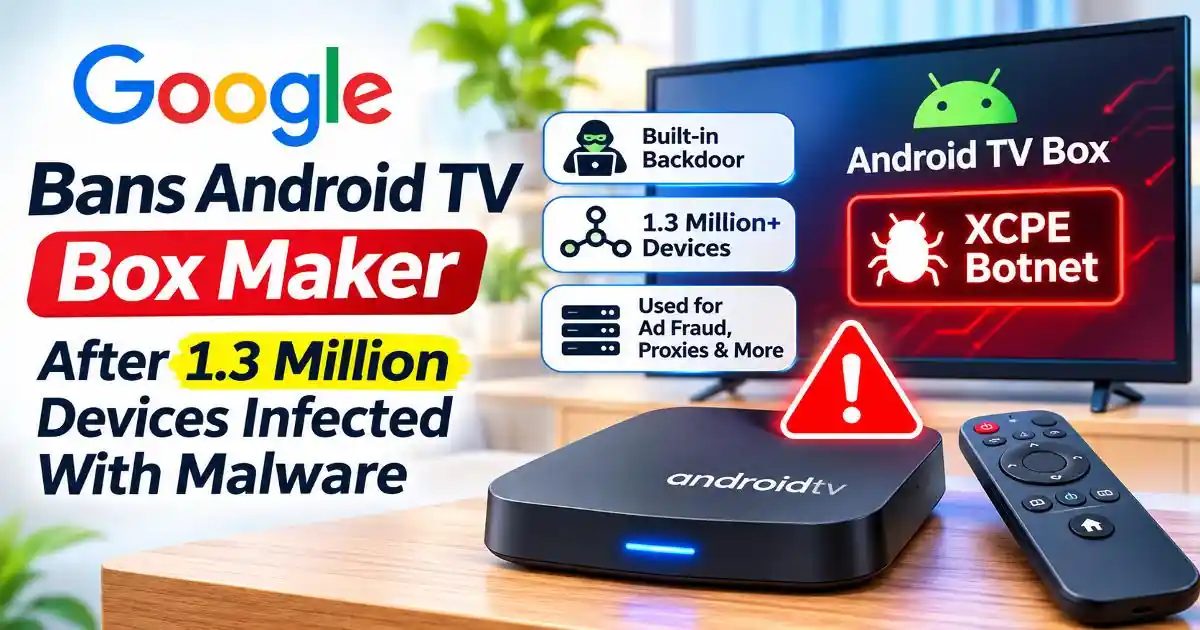
Android TV box malware is usually associated with suspicious applications, unsafe downloads or modified streaming software. The XCPE botnet investigation revealed a more concerning possibility: malicious code can already be embedded in a device's firmware before the customer receives it. On November 2, 2026, Google's Threat Intelligence Group announced that it had worked with security partners to dismantle the XCPE backdoor, which had enrolled more than 1.3 million set-top boxes into a botnet.
Google attributed the operation, with high confidence, to Videostrong Technology Co., an Android original equipment manufacturer (OEM) and original design manufacturer (ODM). According to Google's investigation, the company deliberately developed and operated the backdoor for financial gain, selling access to criminal affiliates who used infected devices for advertising fraud, residential proxy networks and additional malware distribution.
The announcement is significant because the compromised devices were not necessarily purchased from suspicious websites or infected after an owner downloaded an application. Google says the malicious software was built into multiple device models and brands over several years. The investigation also exposed a weakness in the process used to examine certified Android hardware. Google's original XCPE investigation explains the technical findings and coordinated disruption.
What Is the XCPE Android TV Box Malware Incident?
XCPE is a backdoor and malware distribution system that operated through compromised Android-based devices. Its primary component, identified as x.cpe and com.oemservice in some builds, was embedded in device firmware and operated with Android system-level privileges.
Rather than relying entirely on users installing malicious applications, the backdoor gave its operators a way to communicate with infected devices and deploy additional software. This created a platform that could be monetized by multiple criminal affiliates.
Google reported that more than 1.3 million set-top boxes had been enrolled in the XCPE botnet. It also said that disruption of command-and-control domains used by related malware operations could sever access to at least 10 million additional compromised devices. These figures describe different groups: the 1.3 million devices were enrolled through XCPE, while the additional devices were associated with other malware families and distribution channels. They should not be combined into a claim that 11.3 million Android TV boxes were infected by XCPE.
The investigation involved Google, Japan's National Police Agency, Lumen, HUMAN Security, Plume, Synthient and TrendAI. Google also announced that it had cut ties with Videostrong and banned the company and its future affiliates from manufacturing certified Android devices or supplying software to certified vendors.
How the XCPE Firmware Backdoor Worked
The unusual feature of this incident was where the malware lived. Many ordinary Android infections involve an application installed in the user-accessible application area. XCPE used a different approach by placing its primary component in the device firmware.
Google describes a three-stage architecture that evolved from simpler malware into a modular system designed to support multiple monetization operations.
The primary backdoor
The first component, x.cpe or com.oemservice, established communication with remote command-and-control infrastructure. It ran with system-level privileges and could obtain configuration information needed to receive further instructions.
One important technical detail is its persistence mechanism. Google explains that the malware could reinstall itself from the /oem/ partition after removal from the normal application area. This means deleting the visible application does not necessarily eliminate the underlying infection.
The loader and execution engine
The next stage was responsible for loading and executing additional malicious components. Google identified a loader called com.abc.nexus in the malware ecosystem. More recent versions moved towards smaller, more specialized droppers.
This separation made the operation more flexible. The primary backdoor could maintain communication while other components handled specific activities. It also allowed the operators to change the modules without rebuilding the entire malware system each time.
Monetization modules
The final stage involved modules supplied by criminal affiliates. These components turned infected devices into tools for different activities, including ad fraud, residential proxy services and further malware installation.
Google identified proxy-related services and malware families associated with this ecosystem, including Linkfog, AppSalt, NetNut, CBOXTV, HiddenView, Moyu and Spirit. The presence of these names in the investigation does not mean that every infected device ran every module. The software deployed depended on the operators' configuration and instructions.
Why Criminals Wanted Access to Android TV Boxes
A streaming box may appear to be an unimportant device compared with a smartphone or computer. It normally sits beside a television, remains connected to the internet and may stay powered for long periods. These characteristics can make a compromised device useful to remote operators.
One major use was residential proxy networking. A residential proxy routes internet traffic through an ordinary household connection instead of a conventional data-centre server. Criminals can use this arrangement to make their activity appear to originate from a residential IP address.
For an unsuspecting owner, this means that internet traffic they did not initiate could pass through their home connection. Their public IP address might consequently become associated with suspicious activity, automated requests or other third-party operations.
Advertising fraud was another monetization method. Malicious modules could generate artificial advertising activity, including hidden page views and interactions, to create revenue for operators.
Google also documented more intrusive capabilities. Depending on the deployed components, operators could collect device information and account details, capture screenshots, inject keystrokes, execute commands and conduct network reconnaissance. These capabilities demonstrate why a firmware backdoor is more serious than an ordinary unwanted application.
How Did the Malware Get Into Certified Android Devices?
One of the most important questions raised by the XCPE investigation concerns Android certification. Consumers often associate certified Android hardware with Google's compatibility and security requirements.
Google says Videostrong used obfuscation techniques to exploit a gap in its testing process. According to the investigation, malicious code was loaded after the device's first boot, allowing it to avoid detection during parts of the existing review process.
This distinction matters. The incident does not establish that Android certification is meaningless or that all certified devices are compromised. It demonstrates that certification checks have limitations and that manufacturers' firmware practices remain an important part of device security.
Google says it has introduced improvements to its review process and firmware integrity checks for certified Android TV devices to reduce the possibility of similar incidents.
Another important point is that Videostrong supplied hardware across multiple brands and device models. An unfamiliar retail brand does not necessarily reveal which manufacturer originally developed the device. This can make identifying the underlying hardware supplier difficult for consumers.
Are Your MECOOL or Android TV Boxes Affected?
Synthient's investigation describes discovering the backdoor on a MECOOL KM9PRO Max Android TV box purchased in late 2025. Its researchers subsequently investigated the associated infrastructure, software components and connections to Videostrong.
However, Google has not published a complete consumer-facing list of every affected model, serial number and retail brand. Therefore, owning a MECOOL device or another Android streaming box does not automatically establish that it contains XCPE.
It is also important to distinguish between the manufacturer identified in Google's investigation and every company that sells Android TV hardware. Android is used across a large ecosystem of manufacturers, and the XCPE findings should not be treated as evidence against the entire ecosystem.
Owners should pay particular attention to the device's original manufacturer, firmware source, certification status and available security updates. If a manufacturer or seller cannot identify the actual OEM or explain the firmware's origin, that uncertainty deserves consideration when evaluating the device's security.
What Google Did to Disrupt the XCPE Botnet
The November 2 announcement described several coordinated actions rather than a simple malware removal campaign.
Google took legal action to disrupt the domains and servers Videostrong used to control the botnet and distribute malicious modules. It also targeted command-and-control domains associated with more than a dozen malware families that had been loaded through the XCPE ecosystem.
The company ended its relationship with Videostrong and banned the manufacturer, including future subsidiaries and affiliates, from building and selling certified Android devices or supplying software to certified vendors.
Google also worked with its partners to investigate the malware infrastructure and strengthen its firmware review process. These actions are intended to make the botnet's existing operations more difficult and reduce opportunities for similar abuse.
However, disrupting command infrastructure is not the same as cleaning every infected device. The malware can remain embedded in firmware even when the servers controlling it are no longer available.
What Android TV Box Owners Should Do Now
The first step is to avoid assuming that every Android TV box is infected. There is currently no complete public model list that allows all owners to confirm their status using the retail product name alone.
If you own a device from a manufacturer associated with the investigation, contact the seller or manufacturer and ask for the original device manufacturer, firmware version, security update history and any official information about XCPE remediation.
Do not rely on uninstalling an unfamiliar application as a complete solution. Because the primary backdoor can persist in the /oem/ firmware partition and reinstall itself after reboot, ordinary application removal is insufficient.
A standard factory reset should also not be treated as a verified cleanup method for this particular firmware-level threat. Google describes persistence from the OEM partition, which is outside the normal user application area.
If a device is confirmed or strongly suspected to be affected, disconnect it from the internet while seeking a verified remediation path. Do not use it to sign in to important accounts or access sensitive services.
Clean firmware may be a possible remediation option, but it must come from a trustworthy source and be appropriate for the exact hardware revision. Flashing an unofficial firmware image can permanently damage the device or introduce additional security problems. If the manufacturer cannot provide a verifiably clean image, replacing the device with hardware from a reputable supplier may be the more practical option.
Owners should also consider basic home network protection. Keep streaming devices on a separate guest network where the router supports it, avoid granting unnecessary local network access and check whether unfamiliar devices are connected to the home router. Network isolation reduces exposure to other household devices, although it does not remove malware from the streaming box itself.
If you used the device to access accounts or enter sensitive information and have reason to believe that information was exposed, change affected passwords from a separate trusted device and review account activity. Google documented information collection capabilities, but that does not establish that every infected owner experienced account theft.
How to Choose a Safer Android TV Streaming Device
The XCPE incident is a reminder that device security starts before the first application is installed. Consumers should consider the identity of the manufacturer, the availability of firmware updates and the company's willingness to provide security information.
Buy connected devices from established sellers and manufacturers that clearly identify their products and provide a reliable support channel. Check whether the device has the expected Google certification rather than relying on marketing language that simply mentions Android.
Be cautious of unusually inexpensive streaming boxes that promise unlimited premium channels, modified streaming services or features that cannot be independently verified. Such claims do not prove that a device contains malware, but they should encourage closer examination of its origin and software.
Regular security updates, reliable firmware distribution and transparent manufacturer support are more meaningful indicators of long-term device safety than processor specifications or the number of preinstalled applications.
Why the XCPE Incident Matters Beyond Android TV
The larger lesson from XCPE is that connected devices can become part of a criminal infrastructure without their owners knowing. A streaming box can be used as a residential proxy, a platform for advertising fraud or a distribution point for additional malware.
The investigation also demonstrates why supply-chain security matters. Consumers normally evaluate a product through its retail brand, but the firmware may originate from a different manufacturer or development partner. That creates a gap between the company customers recognize and the organization responsible for the software running on their hardware.
Google's response may improve certification checks, but long-term protection requires manufacturers to maintain trustworthy firmware, publish security updates and take responsibility for the software installed on their devices.
For consumers, the practical message is simple: an Android TV box should be treated as an internet-connected computer, not just an accessory for watching television. Its firmware, network access and manufacturer support deserve the same attention as the security of a smartphone or laptop.
Official Sources and Further Reading
- Google Threat Intelligence Group: Shutting the Door on the XCPE Botnet (November 2, 2026) Primary investigation, malware architecture, attribution, affected device scale and disruption actions.
- BleepingComputer: Google Disrupts Million-Device XCPE Android Malware Botnet Independent technical reporting on malware components, command infrastructure and remote capabilities.
- Malwarebytes: A Hidden Backdoor Put 1.3 Million TV Boxes to Work for Criminals Consumer implications and practical response guidance.
- SecurityWeek: Google Dismantles XCPE Botnet of 1.3 Million Android Devices Independent coverage of the disruption and manufacturer restrictions.
- Synthient Security research partner involved in investigating the XCPE ecosystem and its infrastructure.
Frequently Asked Questions
What is the XCPE botnet?
XCPE is a backdoor and botnet that enrolled more than 1.3 million set-top boxes. Google attributes its development and operation with high confidence to Videostrong Technology Co.
Can Android TV box malware survive a factory reset?
XCPE was embedded in firmware and could reinstall itself from the /oem/ partition after removal. A normal factory reset should not be considered a verified way to remove this particular backdoor.
Are all MECOOL Android TV boxes infected?
No complete public list of affected models has been released. A MECOOL brand name alone does not prove that an individual device is infected.
Can an infected Android TV box affect my home internet connection?
Yes. XCPE-related modules could use infected devices as residential proxy nodes, routing third-party internet traffic through the owner's home connection.
What should I do if my Android TV box is affected?
Disconnect it from the internet, contact the manufacturer or seller for verified clean firmware guidance, and consider replacement if a trustworthy remediation option is unavailable.