What Is the Brave Browser Lawsuit About?
The Brave browser lawsuit has brought a new question into the growing debate over artificial intelligence and copyright: can a search company collect publishers’ articles, make that information available to AI businesses and provide tools that may bypass subscription barriers without permission?
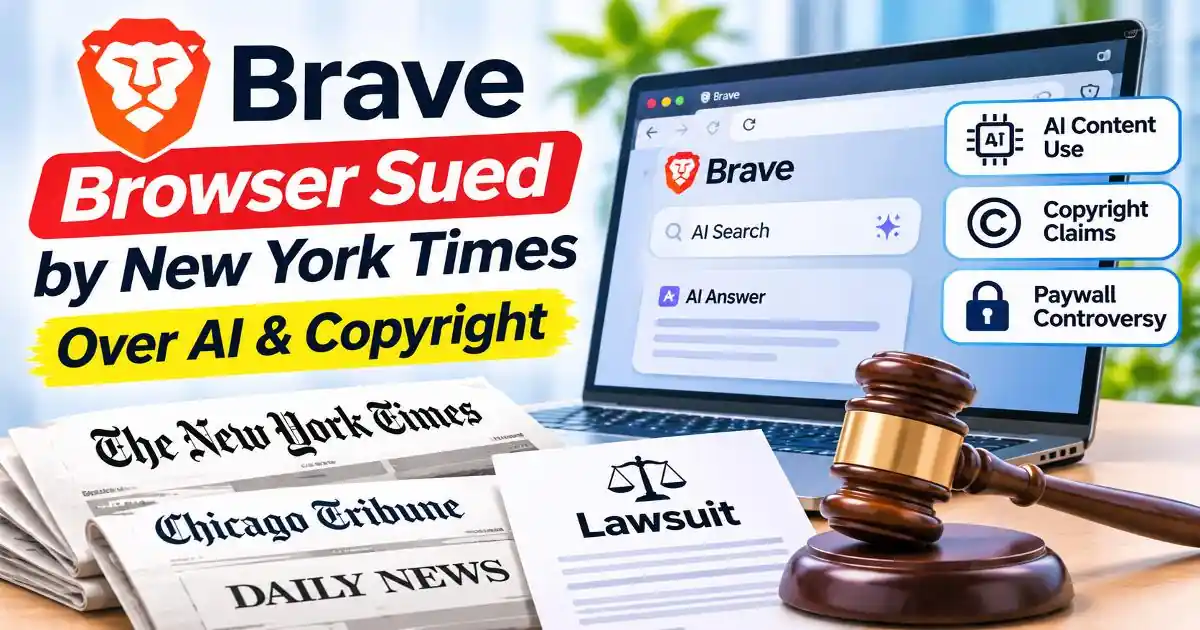
On November 2, 2026, The New York Times Company and a separate group of newspaper publishers filed two lawsuits against Brave Software Inc. in the US District Court for the Southern District of New York. The publishers allege that Brave copied their copyrighted journalism, distributed it through services used by AI companies and offered browser functionality that could bypass publishers’ paywalls.
These are allegations made in court complaints, not proven findings. Brave’s legal position and the court’s assessment will matter as the cases progress. However, the dispute is important because it focuses on the infrastructure that supplies information to AI products, rather than only the companies that develop AI models.
Which Publishers Have Sued Brave?
The dispute involves two separate cases filed on the same day. The first was brought by The New York Times Company under the case name New York Times Co. v. Brave Software Inc., case number 1:26-cv-09549.
The second case was filed by Daily News, LP, Chicago Tribune Company, LLC and Orlando Sentinel Communications Company, LLC. It is listed as Daily News LP v. Brave Software Inc., case number 1:26-cv-09554.
Both complaints name Brave Software as the defendant. They identify AI companies including Anthropic, Perplexity, Mistral, xAI and Cohere in connection with the publishers’ allegations about access to content through Brave’s services. Those companies are not defendants in these two lawsuits.
According to reporting by Reuters and TechCrunch, the publishers are seeking legal remedies over the alleged copying and distribution of their work. The exact outcome will depend on the evidence, legal arguments and decisions made during the court proceedings.
Why Are Publishers Accusing Brave of Copyright Infringement?
Brave operates a privacy-focused browser and Brave Search, an independent search engine. It also offers the Brave Search API, which allows developers to retrieve search information for applications and AI-powered services. Brave describes its search index as independently crawled and maintained rather than dependent on Google or Bing.
The publishers’ complaints challenge how that index and related products allegedly use their journalism. They claim that Brave collected articles from their websites and made substantial amounts of that material available through search and AI-related services without the publishers’ permission or payment.
The complaints also raise concerns about AI-generated answers. When an AI search product provides a detailed answer directly to a user, the user may have less reason to visit the original article. Publishers argue that this can affect the traffic, advertising income and subscriptions that support their reporting.
Brave’s public documentation describes its own crawler, independent index and AI-oriented search services. That description helps explain the technology involved, but it does not by itself resolve the legal question of whether particular uses of copyrighted articles are permitted.
How Brave Search and Its API Fit Into the AI Debate
Traditional search engines generally help users discover webpages by displaying links, titles and short descriptions. AI search tools can use retrieved information to produce a conversational response, sometimes presenting a much larger amount of source material directly on the results page.
Brave’s search infrastructure is relevant because its API provides developers with access to information from its independent index. Its documentation also describes an LLM Context endpoint designed to provide extracted and ranked webpage content for AI applications.
This type of infrastructure can be useful to developers building chatbots, research assistants and other AI tools. Instead of creating their own web index, a developer may use an external search service to find relevant pages and supply information to an AI model.
The legal issue raised by the publishers is whether the collection, extraction and commercial distribution of their copyrighted reporting through such services crossed legal boundaries. Search indexing, displaying snippets, reproducing full articles and supplying text to AI systems can involve different technical and legal questions. They should not automatically be treated as the same activity.
What Is the Paywall Controversy?
The lawsuits also challenge a Brave browser feature that the publishers say can help users get around certain website paywalls. A paywall is a restriction that requires a subscription or payment before a reader can access some or all of an article.
Publishers argue that subscription restrictions are part of their business model and that tools designed to bypass them can undermine paid access. The complaints also raise a separate concern about advertising: the publishers allege that Brave blocks their advertisements while allowing its own advertising model to operate.
These claims are distinct from the allegations about AI search data. A court may need to examine the browser feature, the way it works, the publishers’ technical restrictions and the relevant copyright and anti-circumvention rules. The existence of a paywall-blocking feature does not, on its own, establish that every use of the browser violates the law.
What Could the Brave Lawsuit Mean for Internet Users?
For everyday users, the immediate impact may be limited. The lawsuits do not themselves mean that Brave Browser has been shut down, that Brave Search is unavailable or that users must stop using the browser. They are legal proceedings about the company’s alleged conduct.
However, the cases could influence how browser companies and AI search services handle publisher content. If courts impose restrictions or the parties reach an agreement, some features, data access arrangements or commercial practices could change. That is a possible future outcome, not a confirmed change today.
Users should also understand that privacy and copyright are separate issues. A browser may offer privacy-focused features while still facing questions about how its company collects, processes or distributes website content. A privacy claim does not automatically answer a copyright question.
Why Website Owners and Publishers Should Pay Attention
The dispute is particularly relevant to publishers, bloggers, independent news websites and businesses that depend on organic search traffic. Their content may appear in traditional search results, AI-generated answers, search APIs and other information services.
Website owners should review how their content is made available to crawlers and automated services. They can check their robots.txt rules, review the access controls offered by their hosting or content management platforms, monitor server logs and read the documentation of search and AI services that use their material.
However, technical blocking is not a complete copyright strategy. A robots.txt file communicates crawling preferences, but it is not a universal legal mechanism that guarantees every automated system will comply. Publishers with concerns about unauthorized use should keep records of relevant examples and seek qualified legal advice before taking action.
It is also worth reviewing whether a website’s content licensing terms clearly explain permitted uses, including indexing, excerpts, AI training data and AI-generated summaries. Clear policies can help communicate expectations, although their legal effect depends on the circumstances and applicable law.
Could This Lawsuit Change the Future of AI Search?
The Brave cases are part of a wider conflict over how AI companies obtain information from the open web. Publishers want to protect the value of original reporting, while search and AI businesses argue that access to web information is essential for discovery, research and useful answers.
One important question is whether an intermediary that collects and supplies web content can be held responsible for the way that content is used by its own products or customers. Another is how copyright rules apply when a service provides extracted passages, summaries or source material rather than simply directing users to an original webpage.
The cases may also increase pressure on technology companies to explain where their AI search data comes from, what permissions they have and how publishers can control the use of their work. But no broad legal rule has been established by these complaints alone.
What Happens Next?
The lawsuits will move through the US federal court system. The parties may file responses, challenge the claims, exchange evidence and argue over how copyright and other laws apply to Brave’s products and business practices. The process may take considerable time, and the complaints could be contested before any final decision.
At the time of publication, the reports available on November 3, 2026, did not establish a final court ruling in either case. Brave’s response to the specific allegations should be checked as the proceedings develop. Readers should avoid treating the publishers’ claims as established facts or assuming that every AI company named in the complaints is being sued.
For now, the Brave browser lawsuit is a significant development in the debate over AI, copyright and the economics of online publishing. Its eventual outcome could help clarify the responsibilities of companies that collect, index and supply web content to AI services.
Official Sources and Further Reading
- Reuters – New York Times sues maker of Brave web browser over copyrights
- TechCrunch – New York Times and other outlets sue Brave over alleged content scraping
- The Verge – The New York Times sues Brave Software over AI scraping and paywalls
- Brave Search API documentation
- Brave Search – Indexing, right to be forgotten and right to object