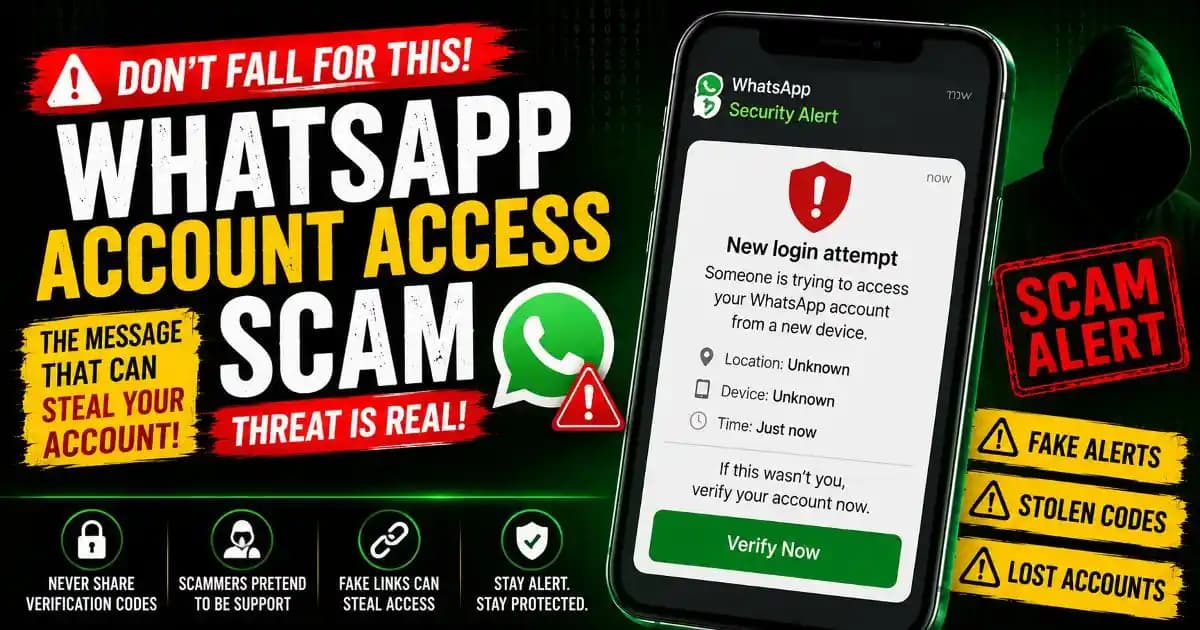
WhatsApp account access scam messages are becoming increasingly convincing as users receive alarming alerts claiming someone is trying to log into their account from another device, city, or country. The message often arrives unexpectedly during an ordinary moment. A notification appears warning about suspicious activity. A supposed verification request appears urgent. Sometimes the scam even includes a fake support contact or a countdown pressuring the user to act immediately.
For many people, the reaction is instinctive. WhatsApp is deeply connected to daily life now. Conversations, family groups, workplace communication, financial discussions, and identity Verification systems all flow through the app continuously. The possibility of losing access feels personal and disruptive.
That emotional urgency is exactly what modern scam operations exploit.
Unlike older phishing attempts filled with obvious errors, newer WhatsApp security scams increasingly imitate the language and visual style of real authentication systems. Attackers study how platforms present warnings, how verification flows appear, and how users respond psychologically to Account security alerts.
The result is a new generation of scams built less around technical hacking and more around behavioral manipulation.
Why WhatsApp Became a Major Target for Scam Ecosystems
WhatsApp evolved far beyond simple messaging.
For millions of users, the platform now functions as:
- A communication hub
- A workplace collaboration tool
- A business support channel
- A family coordination system
- A digital identity layer
- A social verification platform
In many regions, people trust WhatsApp Messages more instinctively than email because conversations feel personal and familiar.
That trust creates enormous value for scammers.
If attackers gain temporary access to a WhatsApp account, they may potentially:
- Impersonate the user
- Target family members
- Request money
- Spread malicious links
- Steal sensitive conversations
- Distribute additional scams
The platform itself becomes both a communication target and a distribution channel.
This is one reason WhatsApp Account scams expanded rapidly during 2025 and 2026 alongside broader growth in Mobile-first fraud ecosystems.
How Fake WhatsApp Security Alerts Usually Work
Most scams begin with urgency.
Users may receive messages claiming:
- Someone tried accessing the account
- A login attempt occurred from another device
- The account may be suspended
- Verification is required immediately
- Security settings changed unexpectedly
- The account risks permanent loss
The message often includes:
- A fake support link
- A verification request
- A suspicious login screenshot
- A one-time password prompt
- A “secure your account” button
Some scams arrive Through SMS. Others appear directly inside WhatsApp itself through compromised Accounts pretending to help.
Many campaigns rely on Social engineering rather than malware. The attacker simply needs the victim to panic long enough to reveal a Verification code or follow a fake authentication flow.
Once the code is shared, account takeover can happen quickly.
Why Verification Codes Became So Valuable
WhatsApp authentication systems rely heavily on mobile number verification.
When users register or transfer an account to another device, the platform sends a one-time verification code through SMS or phone call Confirmation.
Scammers increasingly design fake Security Alerts specifically to obtain this code.
A victim may receive:
- A fake warning message
- A phone call pretending to be support
- A request to “confirm identity”
- A claim that the account must be secured immediately
At nearly the same moment, the attacker initiates a real login attempt, triggering an authentic verification code from WhatsApp.
The victim then unknowingly forwards the real code directly to the scammer.
This approach is effective because the platform’s legitimate security mechanisms become part of the manipulation process itself.
The technology is real. The surrounding narrative is fake.
Why Panic Is Central to the Scam
Modern scam operations increasingly depend on emotional acceleration.
The attacker wants users to react Before critically evaluating the situation.
Security-related panic works especially well because people fear losing Access to:
- Personal conversations
- Family groups
- Business communication
- Photos and files
- Financial discussions
- Social identity
Some fake alerts intentionally include countdown timers, urgent Warnings, or phrases such as:
- “Immediate action required”
- “Unauthorized login detected”
- “Your account will be disabled”
- “Confirm ownership now”
These tactics create psychological pressure.
Under stress, users are more likely to follow instructions quickly rather than independently Verifying whether the alert actually came from WhatsApp itself.
The scam succeeds when urgency interrupts skepticism.
How Compromised Accounts Help Scams Spread
One reason these scams feel believable is because they sometimes come from real contacts.
After taking over an account, attackers may send Messages to family members, coworkers, or group chats pretending to warn about “security issues” or asking for help.
This creates layered trust:
- The message arrives inside WhatsApp
- The sender appears familiar
- The security alert feels plausible
Users naturally trust conversations with known contacts more than random messages.
Some scam campaigns even imitate ordinary support behavior by apologizing for “technical problems” or claiming accounts are under review.
This operational realism reflects how digital fraud evolved during recent years. Attackers increasingly imitate normal platform workflows instead of relying only on obvious deception.
Why Fake Support Accounts Are Increasing
Many scams now involve fake customer support identities.
Attackers may create profiles using:
- WhatsApp logos
- Security-themed usernames
- Official-looking profile images
- Verification-style language
The account may claim to represent:
- WhatsApp Security Team
- Account Recovery Support
- Verification Services
- Technical Protection Teams
Users unfamiliar with how official support systems actually operate may assume the contact is legitimate.
In reality, WhatsApp does not typically message users randomly inside chats asking for verification codes or passwords.
But modern scam design increasingly focuses on blending into ordinary platform behavior rather than looking obviously fraudulent.
How AI Is Quietly Improving Scam Quality
AI-assisted communication systems are changing scam ecosystems significantly.
Older phishing messages often contained awkward grammar or unnatural wording. Modern scam campaigns increasingly produce:
- Localized language
- Natural conversation flow
- Professional formatting
- Convincing support language
- Dynamic responses
This reduces many traditional warning signs users once relied on.
At the same time, legitimate customer support across digital platforms increasingly uses automation and scripted workflows. That overlap makes fake support interactions feel more believable.
Users now interact daily with automated verification systems, AI-powered assistants, and authentication prompts across apps. Scammers increasingly imitate that environment.
The line between genuine operational messaging and manipulation continues becoming harder for ordinary users to recognize instantly.
Why Mobile Devices Make These Scams More Effective
Smartphones encourage rapid reactions.
Notifications appear continuously throughout the day. Users respond while commuting, multitasking, or moving quickly between apps.
Mobile interfaces naturally reduce careful inspection of:
- URLs
- Contact details
- Account authenticity
- Verification context
A message appearing inside WhatsApp feels embedded inside a trusted environment.
That emotional familiarity lowers caution.
Unlike desktop phishing, mobile scams increasingly depend on interruption behavior. The user sees an urgent alert, taps Immediately, and follows instructions before fully evaluating the situation.
This is one reason messaging-based scams expanded rapidly alongside smartphone-centered digital life.
Why Two-Step Verification Matters More Now
WhatsApp introduced additional security layers such as two-step verification partly because account takeover attempts became increasingly common.
When enabled, users create a PIN that adds another barrier during account registration or device transfers.
This does not eliminate every risk, but it reduces the effectiveness of simple verification-code scams.
Modern authentication systems increasingly depend on layered protection rather than relying on phone numbers alone.
As messaging platforms become more connected to identity systems, financial communication, and business workflows, attackers naturally focus more attention on account recovery and verification mechanisms.
The broader trend reflects how digital identity itself shifted toward mobile ecosystems.
How Scam Ecosystems Exploit Human Behavior
The most important thing about WhatsApp account scams is that many succeed without advanced hacking at all.
The victim often voluntarily shares access.
That reflects a major transformation happening across cybersecurity generally. Modern attacks increasingly target:
- Attention
- Urgency
- Trust
- Routine behavior
- Emotional reactions
Scammers study how people respond under pressure, how mobile notifications interrupt thinking patterns, and how platform familiarity reduces skepticism.
Technology itself matters, but behavioral design increasingly matters more.
This is why modern scams often feel psychologically realistic instead of technically complex.
What Users Should Actually Watch For
Users should become cautious when messages:
- Request verification codes
- Create extreme urgency
- Claim unauthorized access suddenly
- Pressure immediate action
- Ask users to “secure” accounts through external links
- Impersonate support systems inside ordinary chats
Independent verification remains one of the safest responses.
Instead of following links inside alarming messages, users Should check account settings directly through the official app itself.
Pausing briefly matters.
Most social engineering scams succeed because users react emotionally before verifying context carefully.
Why WhatsApp Account Access Scams Reflect a Bigger Digital Shift
The rise of WhatsApp account access scams reflects a broader transformation happening across digital life.
Messaging platforms increasingly function as identity ecosystems rather than simple communication tools. They connect Personal relationships, workplace collaboration, financial systems, cloud services, and authentication workflows into a single mobile environment.
That concentration of trust naturally attracts attackers.
At the same time, scam operations evolved beyond obvious spam toward highly contextual manipulation built around ordinary user behavior. Attackers increasingly imitate familiar workflows, security systems, and customer support language instead of relying only on technical exploits.
The future challenge for users is not simply avoiding Suspicious Links. It is learning how to evaluate trust inside digital environments designed around speed, notifications, automation, and emotional immediacy.
For many people, the unsettling part of these scams is not merely that fake alerts exist. It is realizing how easily panic can override judgment when a message appears to threaten something as personal and essential as a messaging account connected to everyday life.
Sometimes the most Dangerous scam is not the loudest one. It is the one that feels operationally normal just long enough to bypass doubt.