The PHP2Shell vulnerability has become a critical cybersecurity concern for website owners after two security flaws in PHP were disclosed on October 21, 2026. The vulnerabilities, tracked as CVE-2026-109618 and CVE-2026-109619, could allow an unauthenticated attacker to execute arbitrary code on an affected server. That means an attacker may not need a legitimate account or password before attempting to exploit a vulnerable system.
India's Computer Emergency Response Team (CERT-In), the Cyber Security Agency of Singapore, and other cybersecurity authorities have issued warnings about the risk. The official CERT-In PHP2Shell advisory describes the potential for remote code execution and system compromise. The PHP security team has released updates to address the flaws, making prompt patching a priority for organizations operating affected systems.
The issue matters because PHP powers server-side functionality across websites, content management systems, online stores, and business applications. However, the vulnerability does not mean every PHP website has been hacked or that every website has to be taken offline. The actual risk depends on the PHP version, server configuration, exposure, and whether the appropriate security update has been applied.
What is the PHP2Shell vulnerability?
PHP is an open-source programming language that processes application logic on web servers. When someone submits a form, uploads a file, signs in, or Requests dynamic content, PHP may handle the request before the server returns a response to the browser.
PHP2Shell is the name used for two critical vulnerabilities affecting the PHP runtime itself. They are associated with problems in memory handling during error processing and request cleanup. Memory-management errors can cause software to access data that is invalid, uninitialized, or has already been released.
The first flaw, CVE-2026-109618, involves improper handling of out-of-memory conditions. The second, CVE-2026-109619, involves stale global state that can retain references to memory that has already been freed.
These are not ordinary website design errors or vulnerabilities limited to a particular plugin. They affect the underlying PHP runtime. Consequently, a website may require a PHP runtime update even when its application code has not changed.
According to the Cyber Security Agency of Singapore's advisory, both vulnerabilities have a CVSS version 4.0 score of 9.2 out of 10. That rating indicates critical risk, although the score alone does not establish that a particular website has been compromised.
How can PHP2Shell put a website at risk?
Remote code execution is one of the most serious categories of software vulnerability because it can allow an attacker to make a vulnerable system execute instructions of their choosing. In the PHP2Shell case, the flaws may be triggered through specially crafted requests that reach vulnerable PHP components.
If exploitation succeeds, the consequences depend on the permissions available to the PHP process and the surrounding server configuration. An attacker may be able to access application files, interfere with website operations, examine sensitive information available to the process, or attempt to establish a more persistent presence.
Server-side memory can also contain sensitive information while an application is running. Depending on the circumstances, this may include credentials, session-related information, or other application data. Successful exploitation may also cause processes to crash, disrupting services.
These outcomes are possibilities rather than guaranteed consequences of every attack attempt. A vulnerable server can remain uncompromised, and security controls may prevent an exploit from succeeding. Nevertheless, organizations should not wait for visible damage before addressing a critical vulnerability.
The Malaysian National Cyber Security Agency's advisory identifies PHP-FPM, Apache mod_php, PHP-CGI, LiteSpeed, and FrankenPHP among the PHP environments that require attention. Administrators should check the actual runtime used by their hosting environment instead of assuming that a website's platform name tells them whether they are affected.
Which PHP versions are affected?
The official security releases provide fixed versions for supported PHP branches. Administrators should compare their installed runtime with the relevant release rather than relying on the latest version number alone.
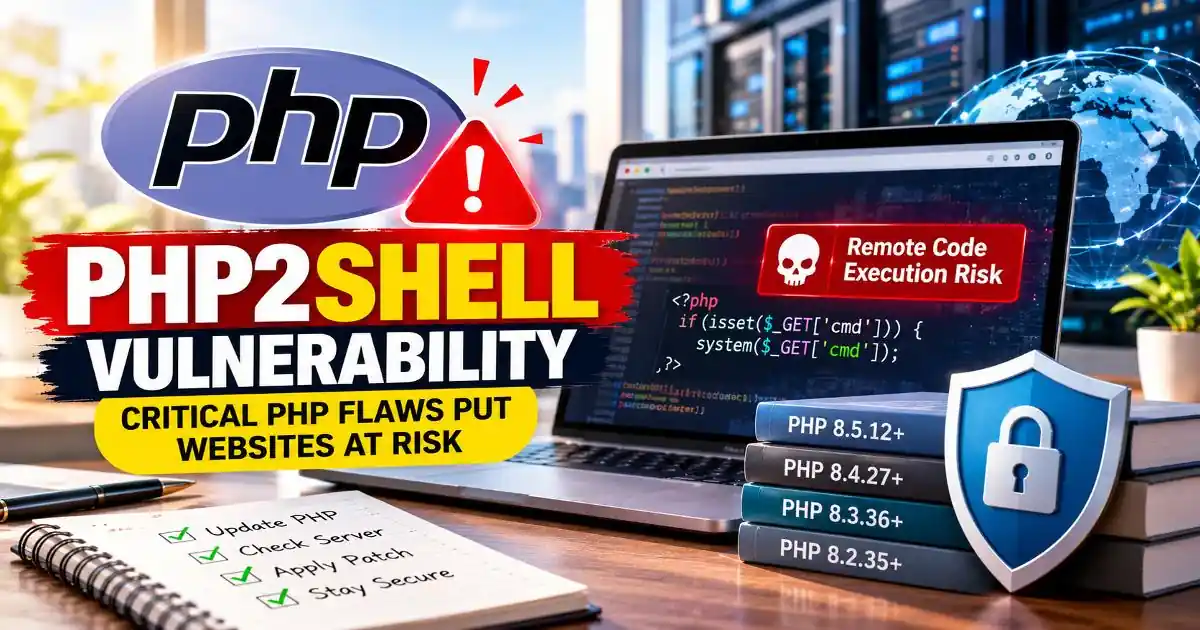
- PHP 8.5: Update to 8.5.12 or a later fixed release in the same branch.
- PHP 8.4: Update to 8.4.27 or a later fixed release in the same branch.
- PHP 8.3: Update to 8.3.36 or a later fixed release in the same branch.
- PHP 8.2: Update to 8.2.35 or a later fixed release in the same branch.
- PHP 8.1 and older: These branches are no longer supported upstream. Organizations should migrate to a supported release or obtain a verified security fix from a trusted vendor where available.
These version targets are based on the NACSA security advisory and related vendor guidance. Hosting providers may distribute patched packages through their own update channels, so administrators should confirm the installed build and vendor-specific remediation status.
Websites using WordPress, Drupal, Joomla, or another PHP-based platform may be affected through their hosting environment. Updating the content management system or a plugin does not necessarily update the PHP runtime itself. Both application dependencies and server components need to be assessed separately.
Why the vulnerability has triggered urgent security warnings
PHP is widely deployed, and a flaw in a shared runtime can affect many independent applications. Administrators may not realize that PHP is installed as a dependency, included with a hosting control panel, or used by a third-party service behind their main website.
Cybersecurity authorities have also warned about exploitation attempts. In its advisory updated on October 23, 2026, Singapore's Cyber Security Agency reported widespread attempts targeting the vulnerabilities and urged organizations to prioritize internet-facing systems. This makes exposure assessment and patch deployment particularly important.
Security reporting must still distinguish attempted exploitation from confirmed compromise. On October 25, Palo Alto Networks' Unit 42 updated its analysis to say it could not confirm that an observed attack against a European government agency had initially exploited these specific PHP2Shell vulnerabilities. That clarification is important: suspicious activity involving a vulnerable PHP application does not, by itself, prove that a particular CVE was the entry point.
Organizations should therefore respond to the confirmed technical risk without making unsupported claims about the number of compromised websites. The existence of a patchable vulnerability is sufficient reason to act, even when the full scale of exploitation remains uncertain.
How website owners should respond to PHP2Shell
Website owners and system administrators should follow the official guidance for their PHP version, operating system, and hosting provider. The objective is to remove the vulnerable runtime, verify that the update is active, and investigate any evidence of activity that occurred before remediation.
- Identify every PHP installation. Check production and staging servers, containers, hosting accounts, control panels, and third-party components. Ask the hosting provider to confirm the actual runtime version where server access is unavailable.
- Install the appropriate security update. Upgrade to a fixed, supported PHP release using official PHP or trusted vendor instructions. Test application compatibility where practical, but do not allow routine maintenance to become an indefinite reason for postponing a critical patch.
- Restart and verify affected services. Ensure PHP workers and related services are running the patched version. A package installation alone may not prove that every running process has loaded the updated code.
- Reduce exposure if an update is delayed. Follow official mitigation guidance and assess whether vulnerable services need to be isolated or temporarily taken offline. Configuration changes may reduce some attack paths, but they should not be treated as a replacement for patching.
- Review logs and system activity. Look for unexpected processes, unexplained file changes, suspicious outbound connections, unusual requests, and abnormal PHP behavior. Investigate findings in context because not every unusual event is evidence of exploitation.
- Respond to suspected compromise. Isolate affected systems when appropriate, preserve evidence, involve qualified security personnel, and rotate potentially exposed credentials from a clean environment. Restore systems from trusted sources if the investigation indicates that recovery is necessary.
The Singapore Cyber Security Agency's official guidance emphasizes immediate updates and prioritization of internet-facing systems. Its recommendations are relevant to organizations that operate public-facing PHP services, including small businesses that depend on managed hosting.
What small businesses and website visitors should know
Small businesses may depend on hosting providers to manage the PHP runtime, which can make it difficult to determine whether a server has been patched. If you use managed hosting, contact the provider and ask whether your active PHP version is affected, whether the security update has been applied, and whether any additional investigation is recommended.
Website visitors generally do not need to change their personal Devices merely because a website runs vulnerable PHP. The main risk concerns the server processing requests. However, if a website operator confirms a breach involving customer data, follow its official instructions and review any relevant account activity.
Organizations should also maintain reliable backups, use least-privilege permissions, protect administrative accounts with multifactor authentication, and keep software supported. These controls cannot eliminate every vulnerability, but they can limit the impact of a successful attack and make recovery more manageable.
Why PHP2Shell matters beyond one security alert
PHP2Shell illustrates why server security cannot rely solely on application updates or perimeter defenses. A vulnerability in the language runtime can affect applications that otherwise appear properly maintained. Organizations need an inventory of software components, a clear patching process, and a way to verify that changes reach production systems.
It also demonstrates the importance of reading security advisories carefully. A critical score describes the potential severity of a vulnerability; it does not mean every server is compromised. Similarly, reports of exploitation attempts should not be presented as confirmed attacks against every vulnerable organization.
For website owners, the most useful response is straightforward: identify affected systems, apply the official fix, verify the running version, and investigate suspicious activity when warranted. If a system cannot be patched promptly, reduce its exposure using trusted guidance while preparing a proper update.
PHP2Shell is a serious warning for anyone responsible for a PHP-based service, but timely remediation and disciplined security practices can substantially reduce the risk. Keeping server software updated is not merely routine maintenance; it is an essential part of protecting websites, customer information, and the services people rely on every day.
Official sources and further reading
- PHP official security release information
- CERT-In advisory on PHP2Shell
- Cyber Security Agency of Singapore advisory
- Malaysia's National Cyber Security Agency advisory
- Palo Alto Networks Unit 42 threat brief and updates