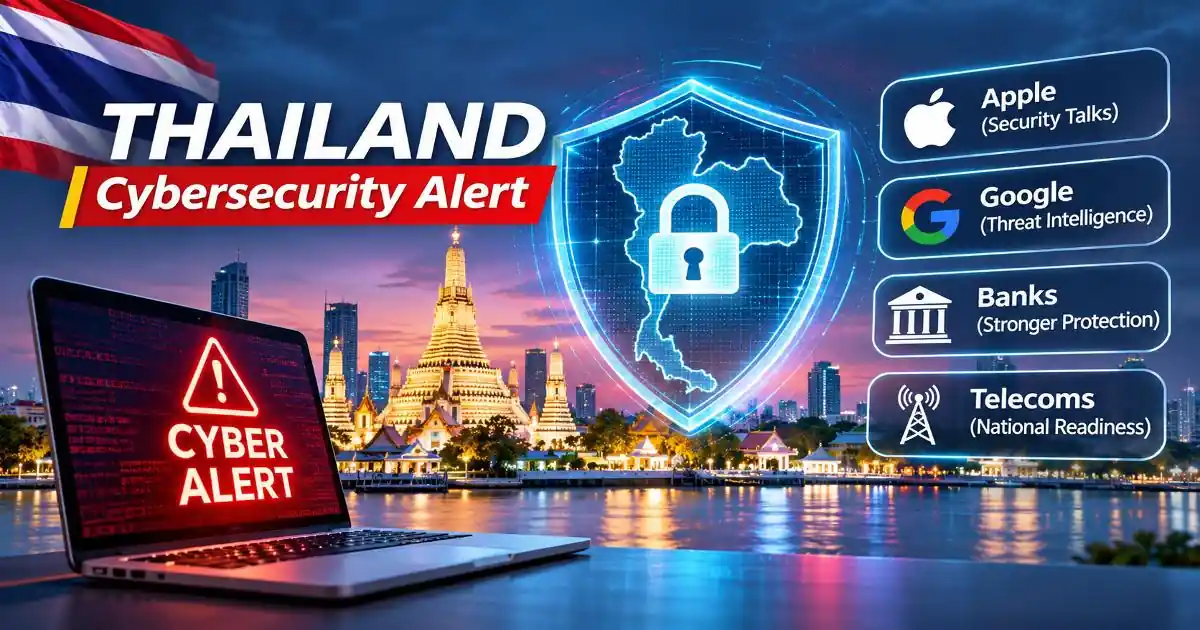
Thailand is strengthening its cybersecurity preparedness as government agencies respond to growing international cyber threats targeting digital infrastructure, financial institutions and communications networks. The country's Ministry of Digital Economy and Society is coordinating with national security agencies, telecom operators and technology companies, including Apple, to improve its ability to detect and respond to emerging attacks.
The developments gained attention after Apple issued a new round of mercenary spyware threat notifications to users in 99 countries. Thailand's government is also concerned about cyberattack attempts against government systems, banks and public utilities, while asking telecommunications operators to prepare for emergencies that could affect communications nationwide.
However, the situation needs to be understood accurately. Thailand has not announced a nationwide banking breach. The Bank of Thailand said it had detected no impact on domestic financial services from the overseas incidents it was monitoring. The government's current response is focused on preparedness, threat intelligence sharing and stronger security controls.
This article explains why Thailand has raised its cyber readiness, what Apple's spyware warnings mean, how banks and telecom operators are preparing, and what individuals and businesses can do to protect their digital accounts and systems.
Why Has Thailand Raised Its Cybersecurity Alert?
Thailand's cybersecurity preparations intensified in early November 2026 after reports of cyber incidents affecting organisations and critical systems in other countries. Prime Minister Anutin Charnvirakul instructed relevant agencies to strengthen prevention and response measures following discussions at the National Security Council.
The National Security Council, National Cyber Security Agency (NCSA), Ministry of Digital Economy and Society, and other agencies have been involved in reviewing the country's readiness against potential attacks.
On November 9, Thailand's National Security Council secretary-general said the country faced daily cyberattack attempts targeting government agencies, banks and public utilities. Officials also warned that attackers were increasingly using artificial intelligence to identify weaknesses in computer systems.
Authorities said the country's critical systems remained under protection, but they emphasised that changing attack methods required continuous monitoring and stronger preparedness.
The government is particularly focused on digital infrastructure that supports financial services, public communications, government operations and sensitive information. A disruption affecting any of these areas could create consequences beyond an individual organisation.
Why Is Thailand Planning Cybersecurity Discussions With Apple?
One of the most notable developments is the planned discussion between Thailand's Ministry of Digital Economy and Society and Apple on November 11, 2026.
Digital Economy and Society Minister Chaichanok Chidchob said the government wanted to gather information from technology developers and security specialists before deciding on a coordinated national response. Discussions were also planned with the National Security Council, national cybersecurity agencies and private-sector technology companies.
Apple's recent mercenary spyware notifications were part of the wider concern. The company had issued a new round of threat notifications to users in 99 countries, warning selected individuals that they may have been targeted by highly sophisticated spyware operations.
Thailand's government wants to understand these threats and improve cooperation with technology companies that have relevant security intelligence and expertise.
As of November 11, the meeting with Apple had been scheduled, but a detailed public outcome or final national strategy had not been established in the reporting reviewed for this article. It would therefore be premature to claim that Apple had announced a new security partnership or that Thailand had introduced a completed nationwide cybersecurity programme as a result.
What Are Apple's Mercenary Spyware Threat Notifications?
Apple's threat notifications are warnings designed for individuals who may have been specifically targeted by mercenary spyware. These attacks are different from ordinary phishing Messages or common malware infections.
Mercenary spyware is sophisticated surveillance software developed or supplied by private companies and used by customers who want to monitor or compromise specific individuals. Potential targets can include journalists, activists, politicians, diplomats and other people whose work or position makes them particularly valuable to an attacker.
These operations can involve significant financial resources, advanced technical capabilities and previously unknown software vulnerabilities. They are generally designed to target a small number of selected individuals rather than large groups of ordinary users.
What does Apple's 99-country warning mean?
Apple issued a new round of notifications in early November 2026 to people it believed may have been targeted by mercenary spyware in 99 countries.
The 99-country figure describes the geographical reach of that notification round. It does not mean that every person in those countries was targeted, that 99 countries were hacked, or that every notified device was successfully compromised.
Apple also does not publicly identify the responsible attackers or geographical origins of these operations. Its official guidance describes the notifications as high-confidence alerts that an individual has been targeted, but it does not provide the technical details that caused each alert.
Does an Apple threat notification mean an iPhone has been hacked?
Not necessarily. A threat notification means Apple has detected activity consistent with a mercenary spyware attack targeting the individual. It should be taken seriously, but it is not automatically proof that spyware successfully compromised the device or that the attacker obtained all its data.
Apple delivers genuine threat notifications through the iPhone Lock Screen, Settings, email associated with the Apple Account, and the account.apple.com website. Users can verify a notification by signing in to account.apple.com directly.
Apple says genuine threat notifications never ask users to click links, install applications or configuration profiles, or provide passwords and Verification codes through email or telephone calls.
How Is Thailand Protecting Its Banking System?
Banking security is one of the government's major priorities because financial institutions depend on interconnected systems for payments, account access, customer information and daily transactions.
On November 9, the Bank of Thailand (BOT) said it was closely monitoring cyber incidents and technology disruptions affecting financial institutions overseas. It confirmed that no corresponding attacks had been detected in Thailand and that domestic financial services had not been affected at the time of its statement.
To strengthen preparedness, the central bank brought together chief technology officers from financial institutions, the Thai Banking Sector Computer Emergency Response Team (TB-CERT), and the Thai Bankers' Association.
The discussions focused on several priorities:
- Sharing information about emerging cyber threats.
- Jointly assessing potential risks to financial institutions.
- Strengthening prevention and incident-response measures.
- Preparing responses for different levels of cyber risk.
- Maintaining compliance with established information-security standards.
- Conducting emergency response exercises under Business Continuity Plans.
These measures are intended to help banks maintain reliable services even if a serious cyber incident affects individual institutions or supporting infrastructure.
Why banking preparedness matters
Modern banking depends on more than a bank's website or mobile application. Payment processing, authentication systems, cloud services, data centres, network providers and third-party technology suppliers can all play a role.
An attack against one part of this ecosystem could affect service availability, expose sensitive information or interrupt transactions. Preparedness exercises help institutions understand how to respond, restore operations and coordinate with other organisations.
Why Are Telecom Operators Being Asked to Prepare for Nationwide Emergencies?
Telecommunications networks are essential infrastructure because they support mobile communications, internet access, digital payments, emergency services and government operations.
Thailand's Ministry of Digital Economy and Society has been working with the National Broadcasting and Telecommunications Commission (NBTC) and the NCSA to review the readiness of telecom operators.
Deputy Minister Nan Boonthida Somchai said operators were being asked to prepare for the highest level of threat readiness, including scenarios involving simultaneous emergencies across the country rather than only local incidents.
Telecom operators were expected to provide updates on their preparedness during the week of November 9. Authorities also emphasised that operators and individual organisations must maintain their own firewall systems and cybersecurity controls.
The distinction is important: overseeing communications infrastructure does not mean a government agency can inspect every piece of data travelling through a network. Organisations must secure their own systems and report unusual activity to the appropriate cybersecurity authorities.
What could happen if telecom infrastructure is disrupted?
A major communications disruption could affect:
- Mobile phone and internet connectivity.
- Digital banking and payment services.
- Emergency communications.
- Government and public-sector operations.
- Business communications and logistics.
- Access to cloud-based applications and online services.
Thailand's preparedness efforts are intended to reduce the risk of these disruptions and improve the ability to maintain essential communications during emergencies.
Thailand's Securities Regulator Is Also Strengthening Cybersecurity
The Bank of Thailand is not the only financial authority responding to the wider threat environment. Thailand's Securities and Exchange Commission (SEC) issued a November 9 statement urging operators in the capital and digital asset markets to strengthen their cybersecurity safeguards.
The regulator said it had already sent a circular on November 3 to supervised businesses, including the Stock Exchange of Thailand and companies in its group, asking them to improve monitoring and preparedness.
The SEC emphasised that cybersecurity is not solely the responsibility of an organisation's IT department. Boards of directors and senior executives must also provide direction, allocate resources, monitor the effectiveness of controls and ensure that security weaknesses are addressed.
Regulated operators were also asked to report the actions they had taken to strengthen their cybersecurity in response to the warning.
This approach reflects a wider lesson for businesses: cyber risk is an organisational and operational issue, not simply a technical problem that can be delegated to IT teams.
What Should Ordinary Users Do to Stay Safe?
Thailand's increased preparedness does not mean ordinary smartphone users need to panic. Most people are not individually targeted by mercenary spyware. However, common threats such as phishing, stolen passwords, malicious applications and account takeover remain relevant to everyone.
1. Keep your devices updated
Install the latest security updates for your smartphone, computer, browser and applications. Updates often fix vulnerabilities that attackers may otherwise exploit.
2. Use strong and unique passwords
Do not reuse the same password across banking, email, social media and shopping accounts. Use a password manager or passkeys where available.
3. Enable multi-factor authentication
Use multi-factor authentication for important accounts, especially email, banking-related services and cloud storage. Where supported, prefer phishing-resistant authentication methods.
4. Be careful with unexpected login approvals
Never approve a sign-in request that you did not initiate. Unexpected authentication prompts may indicate that someone is attempting to access your account using stolen credentials.
5. Verify Apple threat notifications
If Apple sends a mercenary spyware threat notification, take it seriously. Visit account.apple.com directly to verify the alert, follow Apple's recommended security steps and seek expert assistance. Do not trust messages asking you to install an app or share your Apple Account password.
6. Use Lockdown Mode when appropriate
Apple's Lockdown Mode provides additional protection for people who may face highly sophisticated targeted attacks. It restricts certain device features and communication methods to reduce the available attack surface. It is designed for a small group of high-risk users and is not necessary for most people.
7. Monitor banking notifications
Enable transaction alerts through your bank's official application or communication channels. Review unfamiliar transactions and contact your bank immediately if you notice suspicious activity.
8. Avoid suspicious links and attachments
Do not open unexpected attachments or follow links in messages claiming to be urgent security warnings. Check the sender and visit official websites directly instead of relying on links in unsolicited messages.
What Businesses Can Learn From Thailand's Cybersecurity Response
Thailand's response offers useful lessons for businesses in other countries, including India. Organisations that rely on digital banking, telecom services, cloud applications or customer databases should prepare for incidents that may affect more than one system at the same time.
Build a clear incident-response plan
Identify who is responsible for detecting, reporting, containing and recovering from a cybersecurity incident. Employees should know how to report suspicious activity without waiting for a major outage.
Protect critical accounts and infrastructure
Use strong authentication, restrict administrative access and monitor privileged accounts. Keep important systems separate from general user networks wherever practical.
Review third-party technology risks
Cloud providers, software vendors, payment partners and telecom operators can become part of an organisation's wider security exposure. Review their security practices and understand which systems or data they can access.
Maintain tested backups and continuity plans
Back up important information and test recovery procedures regularly. A business continuity plan should explain how essential services can continue if normal systems become unavailable.
Share threat information responsibly
Organisations should establish processes for sharing relevant threat intelligence with industry groups, regulators and national cybersecurity agencies. Timely information sharing can help others identify similar attack patterns.
Make cybersecurity a leadership responsibility
Senior management should understand the organisation's major cyber risks, fund appropriate safeguards and review incident readiness. Security should be included in business planning rather than treated as an isolated technical expense.
What Is Confirmed and What Remains Unclear?
Thailand's cyber preparedness developments involve several different issues. Separating confirmed government actions from wider threat reports helps avoid unnecessary alarm.
| Development | What is known |
|---|---|
| National cybersecurity preparedness | Government agencies have been instructed to strengthen monitoring and response measures. |
| Apple discussions | The Ministry of Digital Economy and Society scheduled discussions with Apple for November 11. A detailed public outcome was not established in the reporting reviewed for this article. |
| Apple spyware notifications | Apple issued a new round of mercenary spyware threat notifications reaching users in 99 countries. |
| Thai banking services | The Bank of Thailand said no impact on domestic financial services had been detected from the overseas incidents it was monitoring. |
| Telecom preparedness | Operators were asked to update readiness plans for potential emergencies affecting local or nationwide communications. |
| Capital market security | The SEC asked supervised businesses to strengthen cybersecurity monitoring, safeguards and incident readiness. |
| Nationwide banking breach | No confirmed nationwide banking breach was announced in the official statements reviewed for this article. |
Frequently Asked Questions
Why has Thailand raised its cybersecurity alert?
Thailand has strengthened cyber preparedness amid reports of increasing international cyber threats, attempted attacks against government and critical systems, and concerns about sophisticated spyware. Government agencies are coordinating to improve monitoring, information sharing and incident response.
Is Thailand under a nationwide cyberattack?
The government has reported daily cyberattack attempts against some Thai systems, but it has not announced a confirmed nationwide cyberattack affecting the entire country. Authorities have said critical systems remain protected while monitoring continues.
Why is Thailand meeting with Apple?
Thailand's Ministry of Digital Economy and Society scheduled discussions with Apple on November 11, 2026, to understand emerging cyber threats, including mercenary spyware, and explore ways to strengthen national cybersecurity preparedness.
Did Apple warn users in 99 countries about spyware?
Yes. Apple issued a new round of mercenary spyware threat notifications to selected individuals in 99 countries in early November 2026. The figure refers to the countries reached by the notification round, not the number of countries successfully hacked.
Does an Apple spyware notification mean my iPhone is hacked?
Not necessarily. It means Apple has detected activity consistent with a mercenary spyware attack targeting the individual. The warning should be taken seriously, but it does not automatically prove that spyware successfully compromised the device.
Are Thai banks affected by the recent cyber threats?
The Bank of Thailand said it had not detected an impact on domestic financial services from the overseas incidents it was monitoring. It has nevertheless asked financial institutions to strengthen their cybersecurity and prepare for potential attacks.
Why are Thai telecom operators increasing their cyber readiness?
Telecommunications networks support internet access, mobile communications, financial services and emergency operations. Thailand wants operators to prepare for incidents that could affect individual areas or communications nationwide.
What should users do if Apple sends a threat notification?
Verify the notification by signing in directly at account.apple.com, follow Apple's official security guidance, update devices and consider Lockdown Mode if recommended. Do not click links or share passwords and verification codes in response to messages claiming to be from Apple.
Official Sources and Further Reading
- Apple Support: About Apple Threat Notifications and Protecting Against Mercenary Spyware explains how genuine notifications work, how to verify them and what targeted users should do.
- Thailand Government: Bank of Thailand Urges Financial Institutions to Strengthen Cybersecurity official summary of banking preparedness and the statement that domestic financial services had not been affected.
- Bank of Thailand: Cybersecurity Preparedness Statement the central bank's November 9 announcement.
- Thailand SEC: Cyber Threat Monitoring and Business Preparedness official guidance for capital-market and digital-asset operators.
- The Nation Thailand: Thailand Plans Discussions With Apple on Cybersecurity Measures reporting on the planned November 11 meeting, telecom readiness and national coordination.
- Khaosod English: Thailand Braces for Cyberattacks reporting on telecom preparedness and government statements.
- The Nation Thailand: Thai NSC Confirms Daily Cyberattack Attempts reporting on government, banking and utility-system threats and the role of AI in vulnerability discovery.
- CERT-In: Advisory on Apple Threat Notifications Indian cybersecurity guidance for users who receive Apple mercenary spyware notifications.
Final Thoughts
Thailand's cybersecurity response shows how governments are adapting to a threat environment that extends beyond traditional computer viruses and phishing campaigns. Banking systems, telecom networks, government services and personal devices all depend on digital infrastructure that must remain secure and available.
The planned discussions with Apple, the Bank of Thailand's coordination with financial institutions, and the telecom sector's updated emergency preparations are different parts of a wider national readiness effort.
For ordinary users, the message is not to panic but to maintain basic security practices. Keep devices updated, use unique passwords, enable multi-factor authentication, verify security alerts and report suspicious activity through official channels.
For businesses, cybersecurity must be treated as an ongoing operational responsibility. Strong access controls, monitoring, tested backups, third-party risk reviews and coordinated incident-response plans can make a significant difference when threats emerge.