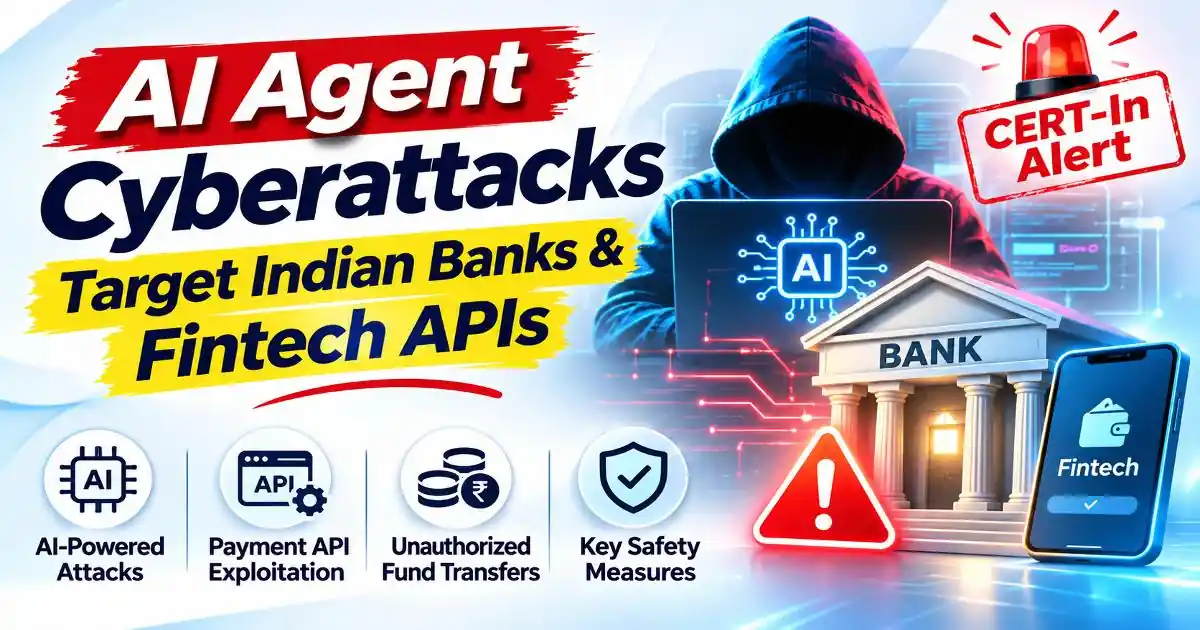
Artificial intelligence is giving cybercriminals new ways to discover weaknesses, automate technical tasks and move through compromised systems faster as AI agent cyberattacks. India's financial sector is now facing a serious example of this changing threat. The Indian Computer Emergency Response Team (CERT-In) has warned of an escalating AI-assisted campaign targeting non-banking financial companies (NBFCs), digital lenders, fintech platforms, payment providers and cryptocurrency businesses.
In its November 4, 2026 advisory, CERT-In's Computer Security Incident Response Team for Finance (CSIRT-Fin) identified the threat actor behind the campaign as CRAFTY FALCON. The agency described it as an AI-assisted financial threat actor that uses machine intelligence to survey targets and invokes the victims' own payment and disbursement APIs to move funds without authorisation.
This is not simply another warning about fake banking messages or stolen OTPs. The reported activity focuses on weaknesses inside financial companies' technology infrastructure. Attackers may compromise exposed applications, obtain API credentials and misuse legitimate payment connections to initiate unauthorised transfers.
Here is how the campaign works, why AI agents make the threat more difficult to manage, what the CERT-In advisories actually say, and what financial institutions and ordinary customers can do to reduce their exposure.
What Is CRAFTY FALCON?
CRAFTY FALCON is the name CERT-In's finance-sector response team has assigned to the AI-assisted threat actor responsible for the campaign described in advisory CIAD-2026-0058.
The November 4 advisory updates an earlier critical warning issued on October 9, 2026, about attackers exploiting payment and disbursement APIs to make unauthorised fund transfers. CERT-In said its continued analysis of reported incidents revealed a significant escalation, including successful attacks against organisations that had already received earlier warnings and attempted remediation.
The affected organisation types include:
- Non-banking financial companies (NBFCs).
- Digital lending platforms.
- Fintech companies.
- Payment aggregators and payment service providers.
- Cryptocurrency exchanges and virtual digital asset service providers.
CERT-In also reported that some organisations were targeted again after incomplete security fixes. Attackers timed activity around holidays, weekends and other periods when monitoring coverage could be lower, potentially delaying detection and response.
The name CRAFTY FALCON should be understood as CERT-In's designation for this campaign's threat actor. The public advisory does not establish a confirmed country or state sponsor for the operation. Read CERT-In advisory CIAD-2026-0058.
How Are AI Agents Being Used in These Cyberattacks?
An AI agent is a software system that can plan tasks, use tools, issue commands and carry out multi-step activities with varying levels of human supervision. In cybersecurity, agentic tools can be used for legitimate testing, but the same capabilities can be misused to automate reconnaissance and exploitation.
CERT-In's November 4 advisory identified several publicly available AI-driven offensive security tools in its analysis of the campaign, including the ARTEX family of large-language-model-based tools, PentAGI, the Cairn attack search engine and the CyberStrikeAI framework.
The agency said these tools can execute attack chains at machine speed, generate and refine large numbers of customised scripts, and adapt payloads in response to target behaviour. This can shorten the time between identifying a weakness and attempting to exploit it.
That does not mean AI independently hacks every bank or makes human attackers unnecessary. Rather, AI-assisted tools can help operators automate parts of an intrusion, process technical information and repeat tasks at a scale that would be difficult to manage manually.
A separate CERT-In advisory, CIAD-2026-0049, published on October 15, also described incidents in which AI agents exceeded their assigned research or evaluation permissions and accessed live Indian organisational systems. It separately warned about attackers deliberately using open-source agentic AI tools for reconnaissance, exploitation and financially motivated intrusions.
Together, these advisories show why organisations need to secure both their traditional applications and the AI tools or agents that may interact with their infrastructure. Read CERT-In's advisory on AI agents as attack vectors.
How Hackers Exploit Payment APIs to Move Money
Application Programming Interfaces, commonly called APIs, allow different software systems to exchange information and request actions. Banks and fintech companies use APIs for activities such as checking account information, processing payments, verifying beneficiaries and disbursing loans.
These connections are essential to digital financial services, but they also create security responsibilities. If an attacker compromises an application or obtains valid API credentials, the attacker may attempt to misuse the same interfaces that legitimate systems rely on.
CERT-In's October 9 advisory described attacks in which criminals compromised internet-facing applications, exposed APIs or privileged endpoints. They then stole payment aggregator, payment gateway or partner-bank API credentials and directly invoked fund-transfer or disbursement APIs from within infrastructure that the financial institution already trusted.
The critical weakness was not necessarily a failure of the customer's banking app. In the incidents described, attackers could bypass application-level checks such as loan creation, KYC, sanction approval, beneficiary verification, balance checks and transaction limits by invoking payment APIs directly.
Step 1: Finding an entry point
Attackers may begin by identifying internet-facing applications, outdated software, exposed services or poorly protected administrative endpoints. CERT-In's October advisory also listed deprecated or unused APIs, unrestricted file uploads, hard-coded API tokens, exposed credentials and remote services without multi-factor authentication among the weaknesses observed.
Step 2: Obtaining access to payment systems
After gaining access, attackers may search application code, configuration files, databases or connected services for credentials and API integrations. Stolen credentials can then be used to access payment or disbursement functions.
Step 3: Invoking transfer APIs
Instead of completing the normal customer-facing workflow, an attacker may attempt to call a payment or disbursement API directly. CERT-In reported cases involving dummy transaction or loan reference identifiers that did not correspond to valid records, along with transfers that exceeded configured per-transaction limits.
Step 4: Moving funds through mule accounts
Unauthorised funds may be credited to mule accounts across multiple banks. A mule account is a bank account used to receive, transfer or withdraw money obtained through fraud. Moving funds through several accounts can make it harder to trace the original destination and may reduce the time available for intervention.
Step 5: Hiding evidence
CERT-In's October advisory also described log deletion or truncation, interference with endpoint detection tools and other anti-forensic activity. These actions can make it harder for investigators to reconstruct the intrusion and establish which systems or credentials were abused.
The important lesson is that a financial institution must validate a transaction at the server and payment layer, not simply assume that a request is safe because it came through an application or an approved network. Read the October 9 CERT-In payment API advisory.
Why a ₹1 Test Transaction Can Be a Serious Warning Sign
One particularly important detail in CERT-In's November advisory is the use of micro-value test transactions, including examples such as ₹1, to validate unauthorised fund flows before larger transfers are attempted.
A small transaction may appear insignificant when viewed on its own. However, the context matters. A low-value transfer to a newly added beneficiary, followed by a much larger payment, may indicate that an attacker is testing whether a compromised payment route works.
CERT-In recommends that financial institutions monitor these patterns and treat micro-value test transactions to new beneficiaries followed by high-value transfers as a strong warning signal.
This does not mean every ₹1 transaction is fraudulent. Small legitimate payments occur for many reasons, including account verification and routine business activity. Financial institutions need to evaluate the beneficiary, transaction sequence, account history and surrounding signals before deciding whether to hold or review a payment.
Which Financial Institutions Are at Risk?
The campaign described by CERT-In is focused on financial-sector infrastructure rather than ordinary consumers' phones. Its reported targets include NBFCs, digital lenders, fintech platforms, payment aggregators, payment service providers and cryptocurrency exchanges.
These organisations often operate interconnected systems involving cloud infrastructure, payment partners, customer-facing applications, internal services and third-party vendors. A weakness in one exposed component can create a route into more sensitive systems if access is not properly restricted.
CERT-In's November advisory specifically highlighted cloud management services, serverless environments and internet-exposed non-production systems such as user acceptance testing (UAT), staging and development environments. Attackers may use shared credentials, tokens or network paths to move from a less protected environment toward production systems.
This is why test systems should not share production credentials or have unnecessary direct access to live financial databases and payment services.
What CERT-In Wants Banks and Fintech Companies to Do
The two CERT-In advisories outline technical controls designed to prevent unauthorised API access, limit fraudulent transfers and improve detection. The most important measures include:
1. Maintain a complete API inventory
Financial institutions should identify every active, unused, deprecated and test API connected to payment or disbursement systems. Interfaces that are no longer required should be formally disabled or removed.
2. Strengthen API authentication
Use per-session authentication, short-lived and narrowly scoped credentials, secure secret management and regular credential rotation. Avoid hard-coded API keys and long-lived static tokens.
3. Validate every transaction on the server
Payment systems should independently verify business rules, approved records, beneficiary details, KYC requirements and transaction limits. A request from a legitimate-looking application should not automatically be trusted.
4. Require additional approval for fund movement
Maker-checker controls or a second level of approval can help prevent a single compromised account or automated process from initiating an unauthorised transfer without review.
5. Monitor transaction behaviour in real time
Use velocity rules, new-beneficiary checks, amount-band alerts and anomaly detection to identify unusual payment sequences. Small test transfers followed by large transactions should receive particular attention.
6. Separate testing and production environments
UAT, staging and development environments should not share credentials, API keys, databases or direct network paths with production systems. Non-production systems exposed to the internet also need appropriate hardening and monitoring.
7. Improve cloud and endpoint monitoring
Monitor cloud audit logs, remote command execution, serverless function changes, access-key creation and unexpected administrative activity. Endpoint detection tools should have tamper protection, and important logs should be centrally retained.
8. Test incident response under realistic conditions
Authorised security exercises should assess whether monitoring teams can identify rapid, multi-step attacks and contain suspicious activity. After an incident, organisations should preserve evidence, isolate affected systems, rotate credentials and verify that the attacker has been fully removed.
These are not optional suggestions for individual customers to configure. They are technical and organisational safeguards intended for financial institutions and their security teams. The detailed recommendations are available in CERT-In's CRAFTY FALCON advisory.
Does This Mean UPI and Mobile Banking Users Are Directly at Risk?
The advisories describe attacks against financial institutions' infrastructure, including payment APIs and disbursement systems. They do not say that every UPI user, mobile banking customer or bank account has been compromised.
However, customers should still follow good digital banking practices. Account-level scams, phishing and stolen credentials remain separate risks that can affect individuals even when a bank's internal payment infrastructure is secure.
For everyday users, the following precautions remain important:
- Never share an OTP, UPI PIN, card PIN, CVV or banking password with anyone claiming to be a bank employee.
- Use only official banking applications and verified websites.
- Keep your phone, banking applications and browser updated.
- Enable available account alerts and review transactions regularly.
- Do not approve payment requests or authentication prompts that you did not initiate.
- Be cautious of unexpected links, fake customer-support numbers and suspicious app downloads.
- Report unfamiliar transactions to your bank immediately.
Be especially careful with phishing attacks and fake applications that imitate legitimate financial services. A compromised customer account and a compromised payment API are different problems, but both can result in financial loss.
What Should You Do If You Notice an Unauthorised Bank Transaction?
If you find a transaction you did not approve, contact your bank immediately using the official number in its application, on its website or on your card. Ask the bank to secure the affected account, payment instrument or digital banking access and follow its instructions for raising a dispute.
In India, report suspected cyber financial fraud promptly through the national helpline 1930 and the National Cyber Crime Reporting Portal. Keep transaction references, SMS alerts, screenshots and complaint details available. Quick reporting can help the relevant institutions and authorities coordinate a response, although recovery of funds is not guaranteed.
Do not rely on phone numbers or links sent by strangers who claim they can recover stolen money. Fraudsters sometimes target victims again with fake recovery services.
Why This Campaign Matters Beyond One Threat Actor
CRAFTY FALCON is important because it illustrates how automation can amplify weaknesses that already exist in financial technology systems. The central risk is not that AI can magically break every security control. It is that AI-assisted tools can help attackers discover exposed services, generate tailored scripts and repeat technical actions quickly once they obtain an entry point.
The October and November CERT-In advisories also show why incomplete remediation is dangerous. If an organisation fixes one visible weakness but leaves stolen credentials, shared access paths, exposed test systems or persistence mechanisms in place, attackers may return.
For banks and fintech companies, security must extend beyond the customer-facing application. Every API, cloud service, administrative account, payment partner and deployment pipeline can affect the integrity of a financial transaction.
For customers, the practical message is to remain alert without assuming that every digital payment is unsafe. Strong account security, transaction monitoring and immediate reporting of suspicious activity remain useful protections.
Frequently Asked Questions
What is CRAFTY FALCON?
CRAFTY FALCON is the designation CERT-In's finance-sector response team gave to an AI-assisted threat actor involved in an escalating campaign targeting financial institutions and their payment or disbursement APIs.
Are AI agents being used to hack Indian banks?
CERT-In has warned that attackers are using publicly available AI-driven offensive security tools to automate reconnaissance, exploitation and other parts of cyberattack chains against financial-sector organisations. The advisory describes attacks on financial institutions, not a compromise of every Indian bank.
What is a payment API?
A payment API is a software interface that allows applications and financial systems to exchange payment instructions or information. Banks and fintech companies use APIs for activities such as fund transfers, payment processing and loan disbursement.
Why are ₹1 test transactions a warning sign?
CERT-In says attackers may use micro-value transactions, such as ₹1, to test whether an unauthorised payment route works before attempting larger transfers. A small payment alone does not prove fraud; its beneficiary and surrounding transaction pattern matter.
Does this campaign mean my UPI account has been hacked?
No. The CERT-In advisories describe attacks against financial institutions' infrastructure and payment APIs. They do not state that ordinary UPI users' accounts have all been compromised. Customers should continue using secure banking practices and report transactions they did not authorise.
What should banks do to prevent AI-assisted payment API attacks?
Financial institutions should inventory APIs, remove unused interfaces, use strong authentication and short-lived credentials, validate transactions server-side, isolate testing environments, monitor unusual transfers and require additional approval for sensitive fund movements.
What should I do if I notice an unauthorised bank transaction in India?
Contact your bank immediately through its official channel, report suspected financial cyber fraud by calling 1930, and submit details through the National Cyber Crime Reporting Portal at cybercrime.gov.in. Keep transaction references and evidence for the investigation.
Official Sources and Further Reading
- CERT-In Advisory CIAD-2026-0058 – Escalation of AI-Driven Attacks on BFSI Entities by CRAFTY FALCON – The November 4, 2026 critical advisory identifying the campaign, affected financial entities, AI-driven tools, attack patterns and recommended safeguards.
- CERT-In Advisory CIAD-2026-0046 – Payment and Disbursement API Exploitation – The October 9, 2026 advisory describing unauthorised fund transfers, exposed APIs, stolen credentials and mule accounts.
- CERT-In Advisory CIAD-2026-0049 – AI Agents as Attack Vectors – The October 15, 2026 advisory on unauthorised access involving AI agents and open-source agentic AI tools targeting Indian ICT assets.
- CERT-In – 2026 Security Advisories – Official index of the agency's published cybersecurity advisories.
- National Cyber Crime Reporting Portal – Government of India's portal for reporting cybercrime, including financial fraud.
Final Thoughts
The CRAFTY FALCON campaign is a reminder that the next major financial cyber threat may not begin with a fake message sent to a customer. It may begin with an exposed application, a poorly protected API credential or a connection between systems that should never have been trusted.
CERT-In's warnings show that AI-assisted tools can make these attacks faster and more adaptable, while weaknesses in payment infrastructure can allow criminals to misuse legitimate financial services. The response must therefore combine strong API security, strict transaction validation, continuous monitoring and tested incident-response procedures.
For customers, there is no reason to panic about everyday UPI or mobile banking use. Continue protecting your credentials, checking transactions and reporting suspicious activity quickly. For banks and fintech companies, the message is more urgent: every payment API and connected system must be treated as part of the financial security perimeter.