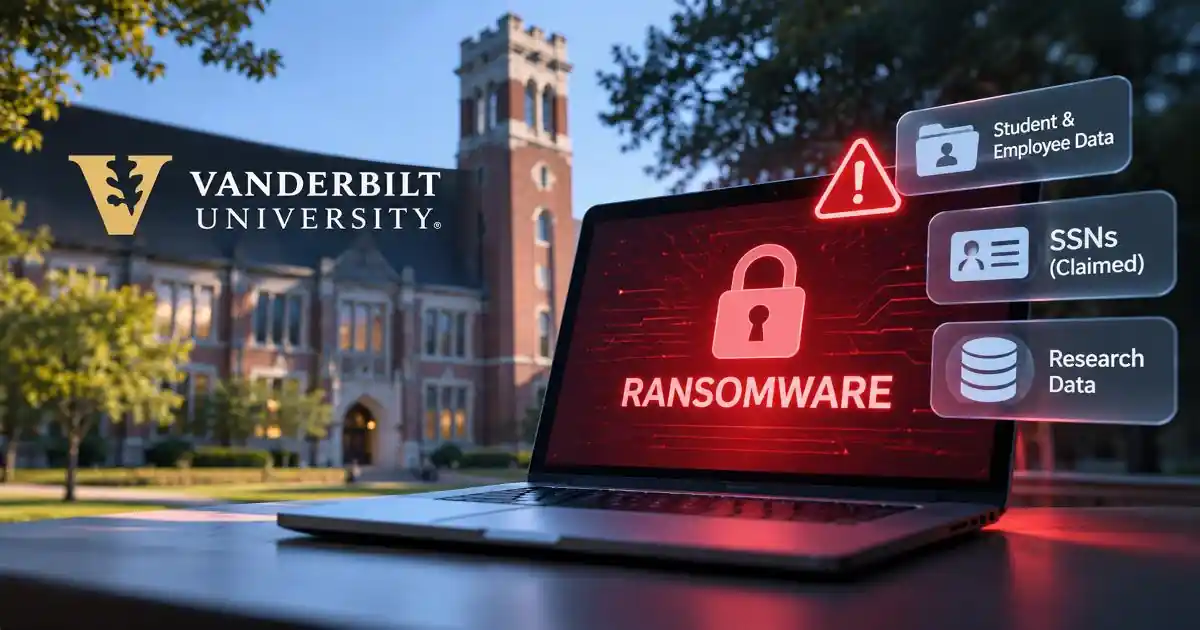
Vanderbilt University is responding to an active cybersecurity incident after a ransomware group calling itself BYOD claimed responsibility for an attack on the institution's systems. The group alleges that it encrypted university databases and stole sensitive information, including more than one million Social Security numbers (SSNs), student and employee records, contact details, and research data.
Vanderbilt confirmed on November 9, 2026, that its university devices, systems, and cloud-based services may be affected. The university instructed students, faculty, and staff to shut down university devices, disconnect from campus Wi-Fi, and report suspicious activity to its IT team.
However, an important distinction remains: Vanderbilt has not publicly confirmed BYOD's involvement, the alleged database encryption, or the group's claim that it obtained more than one million SSNs. The number comes from the attackers' statement, not a verified university disclosure.
The incident highlights the cybersecurity challenges facing universities, which manage large networks of students, employees, researchers, cloud applications, and sensitive institutional information. This article explains what happened, what the ransomware group claims, why the university issued device shutdown instructions, and how educational institutions can reduce similar risks.
What Happened in the Vanderbilt University Cyberattack?
On November 9, 2026, Vanderbilt University announced that it was responding to an active cybersecurity incident that could affect university devices, internal systems, and cloud-based services. Its Information Technology team said it was investigating the situation and working to contain the incident.
The university initially asked members of its community to shut down university devices and disconnect from university Wi-Fi. It also warned users to watch for unusual activity, including unexpected pop-ups, security warnings, changes to files stored in OneDrive or Box, unfamiliar applications, and unexpected Requests to enter passwords or approve authentication requests.
Later that day, Vanderbilt published another update. Campus Wi-Fi was available again, but access to most university systems and applications remained restricted. The university said it was working with government agencies and other partners to manage the incident.
Vanderbilt announced that classes and normal university operations would proceed on November 10, while asking students to contact their instructors for additional guidance about coursework deadlines. The university said it would provide another update on the status of its systems and applications.
The disruption affected more than just access to campus computers. Online services are used for coursework, research, administrative work, communication, and other university activities. Restricting access can therefore create significant operational challenges even while classes continue.
What Does the BYOD Ransomware Group Claim?
On November 9, a group calling itself BYOD added Vanderbilt University to its data-leak website and claimed responsibility for the incident. According to reporting by BleepingComputer, the group alleged that it had encrypted university databases and obtained information from the institution's network.
The group's claims included:
- More than one million Social Security numbers.
- Full names and email addresses.
- Phone numbers and other contact information.
- Student and employee records.
- Research data and other university information.
- Access to the university's domain controller and wider network environment.
BleepingComputer also reported receiving a photograph of a ransom note associated with BYOD. The message reportedly directed the university to contact the group through an encrypted messaging service and threatened to release information if negotiations did not take place.
These details provide evidence that the ransomware group is claiming responsibility, but they do not independently establish the full extent of the incident. Vanderbilt has not confirmed that the group successfully encrypted its databases, stole the listed information, or obtained the number of records it claims.
Was Data Belonging to More Than One Million People Stolen?
At the time of the latest public university update reviewed for this article, Vanderbilt had not confirmed the alleged theft of more than one million Social Security numbers.
The distinction between an attacker claim and a confirmed data breach is important. Ransomware groups sometimes publish large figures to create pressure on victims, attract attention, or encourage negotiations. Their statements should not Automatically be treated as verified incident statistics.
There is also a difference between the number of identifiers claimed, the number of records in a dataset, and the number of unique individuals affected. One person may have multiple records, and a dataset may contain duplicate or incomplete information.
For now, the responsible way to describe this development is that BYOD claims to have obtained more than one million SSNs, but Vanderbilt has not publicly verified the claim.
Students, employees, and former members of the university community should follow official university communications for confirmed information about possible personal-data exposure. They should not assume that their Social Security numbers have been stolen solely because the ransomware group made the claim.
Why Did Vanderbilt Tell Students and Staff to Shut Down Their Devices?
One of the most unusual aspects of the incident was Vanderbilt's instruction to shut down university devices and disconnect from campus Wi-Fi. This was an emergency precaution while the IT team investigated suspicious activity and worked to contain the situation.
The university identified several warning signs that users should report:
- Unexpected pop-ups, warnings, or security notifications.
- Unusual changes to files, folders, or permissions in OneDrive, Box, or other cloud storage platforms.
- Files unexpectedly moved, deleted, renamed, or modified.
- Unfamiliar applications, messages, or prompts appearing on a device.
- Unexpected requests to enter passwords or approve authentication requests.
- Other unusual device behaviour that the user cannot explain.
These symptoms can indicate unauthorized access, malicious software, or an attempt to manipulate a user's account or device. They are warning signs, not proof by themselves that ransomware has been installed.
Why shutting down can help during an active incident
When an organisation suspects that a device is involved in an active security incident, disconnecting it from networks can help limit further communication with compromised systems. Following an organisation's specific shutdown instruction can also reduce the risk of users interacting with malicious prompts or accidentally changing evidence while investigators assess the incident.
However, device shutdown is not a universal response for every ransomware warning. In some investigations, security teams may need a device to remain powered on to preserve volatile evidence. The correct action depends on the incident-response team's instructions.
In Vanderbilt's case, the university explicitly instructed community members to shut down university devices if they noticed suspicious activity. It also told them not to investigate or troubleshoot the issue themselves.
What Is a Domain Controller and Why Would Attackers Target It?
One of the claims made by BYOD concerns access to Vanderbilt's domain controller. A domain controller is a server that helps manage identities, authentication, and access permissions in a Windows-based network using Active Directory or related directory services.
In a large organisation, domain controllers can play a central role in deciding which users and computers are allowed to access network resources. They help administrators manage accounts, apply security policies, and control access to shared services.
Attackers who gain privileged access to a domain controller may be able to create or modify accounts, change access permissions, interfere with security policies, or move further through an organisation's network. The exact opportunities depend on the environment and the permissions obtained.
This makes identity infrastructure an important target during ransomware incidents. Compromising central authentication systems can potentially give attackers more control than compromising a single employee workstation.
However, BYOD's claim of a full domain-controller takeover has not been confirmed by Vanderbilt. It should be described as an allegation rather than an established technical finding.
How Can Ransomware Disrupt a University?
Universities are complex technology environments. They support thousands of users, multiple departments, research facilities, administrative offices, cloud platforms, and external partnerships. This creates a large digital environment that security teams must protect.
1. Central identity and account systems
University accounts may provide access to email, learning platforms, research resources, shared storage, administrative systems, and other services. If attackers compromise privileged accounts, they may be able to reach more systems than an ordinary user can access.
2. Cloud storage and collaboration tools
Students and employees frequently use services such as OneDrive and Box to store documents and collaborate. Vanderbilt specifically warned users about unexpected changes to files and permissions in these platforms.
Unusual file activity can be a warning sign of unauthorized access or malicious automation. Organisations should monitor unusual downloads, mass file changes, deletion activity, and unexpected permission modifications.
3. Research data and intellectual property
Universities hold valuable research information, unpublished studies, grant-related documents, experimental results, and intellectual property. Attackers may attempt to steal this information and use it as leverage during extortion.
However, the BYOD claim that it obtained Vanderbilt research data has not been independently confirmed.
4. Operational disruption
Even without confirmed data theft, restricting university systems can interrupt teaching, research, administration, and student services. Universities may need to temporarily disable applications or network access while investigating suspicious activity.
Are Vanderbilt Health Systems Also Affected?
Vanderbilt Health published a separate notice on November 9 advising its employees not to access Vanderbilt University's IT resources until further notice. It also told staff not to connect removable media, including USB drives, laptops, or external storage devices, to university systems.
Vanderbilt Health said its own systems had not been impacted at the time of that notice and that patient care was continuing at its hospital and clinical locations. It said it was monitoring the university's situation and taking precautions.
This distinction matters because a university and its affiliated health organisation may operate separate technology environments. A cybersecurity incident affecting one environment does not automatically mean that every affiliated service or hospital system has been compromised.
Based on the public notice, Vanderbilt Health was taking precautionary measures while reporting that its own systems had not been affected at that time. Readers should consult subsequent official updates for any change in status.
What Should Vanderbilt Students and Employees Do?
Anyone connected to Vanderbilt should follow the university's official incident-response instructions rather than rely on messages circulating on social media or unofficial websites.
1. Follow the university's device instructions
If you are a Vanderbilt community member, follow the university's current instructions for university-owned devices and systems. If you observe suspicious activity, do not click unexpected links, pop-ups, attachments, or unfamiliar prompts. Vanderbilt specifically instructed users to shut down affected university devices and contact its IT Service Desk using a separate device or telephone.
2. Do not approve unexpected login requests
Unexpected authentication prompts can be used to trick users into approving access they did not initiate. Never approve a sign-in request simply because it appears on your phone. If you did not attempt to log in, deny the request and report it through the organisation's official security channel.
3. Be alert for incident-themed phishing
Attackers may exploit public concern about a university breach by sending fake security notices, password-reset requests, or messages claiming to provide updates about affected accounts. Verify unexpected communications independently before opening links or providing information.
4. Protect personal email and other accounts
If you use the same password for university and personal accounts, replace reused passwords with unique ones. Secure your personal email account because it may be used to reset access to other services. Enable multi-factor authentication wherever available.
5. Monitor financial and identity-related activity
Do not assume that your Social Security number has been exposed based solely on the ransomware group's claim. However, remain alert to unexpected account notifications, suspicious credit-related activity, or messages requesting identity information. If Vanderbilt confirms that your personal information was affected, follow its specific guidance and any applicable identity-protection recommendations.
6. Contact university IT through verified channels
Use contact information published through official Vanderbilt channels. Avoid phone numbers, email addresses, or links supplied by unknown accounts claiming to help victims of the incident.
How Universities Can Prevent Similar Ransomware Attacks
The Vanderbilt incident highlights several security controls that higher-education institutions should prioritise. These measures can reduce the risk of ransomware spreading and limit the damage if an attacker gains access.
Use multi-factor authentication for important accounts
Require multi-factor authentication for administrators, remote access, cloud applications, and other sensitive services. Phishing-resistant authentication methods can provide stronger protection than passwords alone.
Protect privileged accounts
Separate everyday user accounts from administrative accounts. Limit the number of users with domain-level privileges, review privileged access regularly, and use dedicated administrative workstations where appropriate.
Monitor identity and domain-controller activity
Collect and review authentication logs, privileged account changes, new account creation, unusual login patterns, and suspicious access to directory services. Alert on unexpected changes to security policies and administrative permissions.
Secure cloud storage and collaboration platforms
Monitor large-scale file downloads, unexpected file deletions, unusual sharing activity, and sudden permission changes. Apply least-privilege access so users and applications can access only the information they need.
Maintain isolated and tested backups
Keep backups separate from ordinary production accounts and networks. Use protected or immutable backup storage where appropriate, and regularly test restoration procedures. A backup is useful only if the organisation can restore clean data and systems when needed.
Segment networks and restrict remote access
Separate sensitive research environments, administrative systems, user devices, and other critical services where appropriate. Restrict remote access to approved pathways and require strong authentication.
Prepare a ransomware response plan
Universities should define who can isolate systems, communicate with users, coordinate with law enforcement, preserve forensic evidence, restore services, and assess privacy obligations. Tabletop exercises can help teams practise these decisions before an incident occurs.
Train students and employees to recognise suspicious activity
Users should know how to report unexpected login prompts, suspicious files, unusual pop-ups, and unfamiliar applications. Clear reporting channels can help security teams investigate potential incidents sooner.
What Is Still Unconfirmed About the Vanderbilt Incident?
Because this is a developing incident, it is important to separate public university statements from claims made by the ransomware group.
| Question | Current public status |
|---|---|
| Did Vanderbilt confirm a cybersecurity incident? | Yes. The university confirmed an active incident affecting or potentially affecting devices, systems, and cloud services. |
| Did BYOD carry out the attack? | BYOD claimed responsibility, but Vanderbilt has not publicly confirmed the group's involvement. |
| Were university databases encrypted? | BYOD claims they were encrypted. Vanderbilt has not publicly confirmed this. |
| Were more than one million SSNs stolen? | This is the group's claim. Vanderbilt has not verified the number or confirmed the alleged theft. |
| Was research data stolen? | BYOD claims it obtained research data. The university has not publicly confirmed this. |
| Were Vanderbilt Health systems affected? | Vanderbilt Health said its systems had not been impacted at the time of its November 9 notice. |
| Was the incident fully resolved? | Not according to the latest public update reviewed for this article. Most university systems and applications remained restricted in the November 9 evening update. |
These details may change as Vanderbilt and relevant authorities continue their investigation. The university's official incident updates should be treated as the primary source for confirmed developments.
Frequently Asked Questions
Was Vanderbilt University hacked in November 2026?
Vanderbilt confirmed an active cybersecurity incident on November 9, 2026, affecting or potentially affecting university devices, systems, and cloud-based services. The university said its IT team was investigating and working to contain the situation.
Who is the BYOD ransomware group?
BYOD is a ransomware group that claimed responsibility for the Vanderbilt incident on its data-leak website. BleepingComputer reported that the group also provided a ransom note associated with its claim. Vanderbilt has not publicly confirmed that BYOD was responsible.
Did hackers steal more than one million Social Security numbers?
BYOD claims to have obtained more than one million Social Security numbers, but Vanderbilt has not publicly confirmed the alleged data theft or the number. The figure should be treated as an unverified attacker claim.
Why did Vanderbilt ask students to shut down their computers?
The university was investigating suspicious activity that could affect its devices, systems, and cloud services. It instructed users who noticed unusual activity to avoid clicking suspicious prompts, shut down affected university devices, and contact IT through a separate device or telephone.
Was Vanderbilt Health affected by the cyberattack?
Vanderbilt Health said on November 9 that its own systems had not been impacted at the time of its notice. It advised employees not to access university IT resources while the investigation continued and said patient care was continuing.
What is a domain controller in a ransomware attack?
A domain controller is a server that manages authentication and access within a Windows-based organisational network. If attackers obtain privileged access, they may be able to alter accounts, permissions, or security policies and potentially expand their access across the network.
Should Vanderbilt students change their passwords?
Students should follow official Vanderbilt instructions and change any reused passwords on personal services. They should enable multi-factor authentication, reject unexpected login approvals, and use only verified university communications for incident guidance.
Has Vanderbilt confirmed that the ransomware attack is over?
The latest public university update reviewed for this article said that access to most university systems and applications remained restricted while the investigation continued. Vanderbilt had not publicly declared the incident fully resolved in that update.
Official Sources and Further Reading
- Vanderbilt University: November 9 Active Cybersecurity Incident Updates the university's official incident announcement, device instructions, Wi-Fi update, and operational guidance.
- Vanderbilt Health: Alert About Access to University IT Resources health-system precautions and its statement about the status of its own systems.
- BleepingComputer: Vanderbilt University Hit in BYOD Ransomware Attack, Data Theft Claimed reporting on BYOD's claims and the alleged ransom note.
- The Washington Post: Vanderbilt University Shuts Down Devices After Cyberattack reporting on the university's response and the unverified data-theft claims.
- Axios: Vanderbilt Urges Campus to Shut Down Computers Amid Cyberattack coverage of the campus response and disruption.
- CISA: StopRansomware general ransomware prevention, response, and recovery guidance for organisations.
Final Thoughts
The Vanderbilt University incident demonstrates how a cybersecurity emergency can disrupt a large educational institution even before the full extent of an attack is publicly known. The university restricted access to systems, instructed users to shut down devices showing suspicious behaviour, and worked with government agencies to investigate the incident.
BYOD's claim that it stole more than one million Social Security numbers is serious, but it remains unverified by Vanderbilt. Until the university publishes confirmed findings, readers should avoid repeating the figure as an established breach count or assuming that every student and employee has been affected.
For universities and other large organisations, the incident is a reminder to protect identity systems, privileged accounts, cloud storage, research environments, and backups. Strong authentication, network segmentation, monitoring, and a well-practised incident-response plan can help reduce the impact of ransomware.
For students and employees, the most important step is to follow official security instructions, report suspicious activity, and verify communications before sharing credentials or personal information.