AI Cybersecurity Incidents 2026 Reveal a Bigger Software Trust Problem
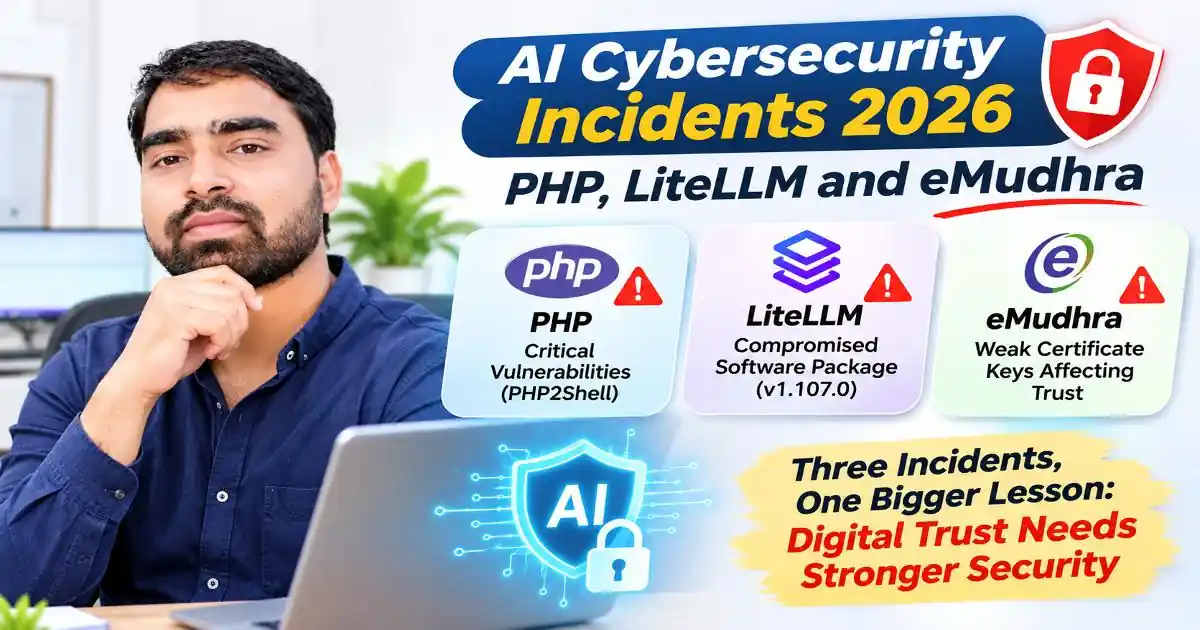
AI cybersecurity incidents 2026 have brought an important question into focus: how much should organizations trust the software, development tools and digital services they depend on? A critical PHP vulnerability, a compromised LiteLLM package and weak eMudhra certificate keys recently exposed different weaknesses in the technology ecosystem. The incidents were not part of one coordinated attack, but they illustrate how a failure in one trusted component can affect systems far beyond its original boundary.
Artificial intelligence is part of this story, but not in the simplistic sense that AI caused every incident. AI-assisted research helped identify or investigate some weaknesses, while the LiteLLM compromise involved stolen credentials and manipulation of a software release pipeline. The more useful lesson is that faster vulnerability discovery must be matched by stronger software maintenance, credential protection and independent Verification.
Why These Three Security Incidents Matter Together
Modern applications depend on layers of technology. A website may rely on a programming language such as PHP, a collection of third-party libraries, cloud services, developer credentials and trusted digital certificates. Users rarely see these components, but they help determine whether an application operates safely.
The recent incidents affected three different layers:
- Application runtime: PHP2Shell exposed critical weaknesses in the PHP runtime that could allow unauthenticated remote code execution.
- Software dependencies: A compromised LiteLLM 1.107.0 release demonstrated how a malicious package can enter a trusted distribution channel.
- Digital identity: Weak eMudhra intermediate certificate keys raised concerns about the trust used to authenticate websites through HTTPS.
These events should be understood separately. Their value as a combined story comes from the common lesson: organizations cannot treat a familiar software name, a successful build, a security certificate or an AI-powered development workflow as automatic proof of safety.
PHP2Shell: When a Vulnerability Exists Below the Application
PHP2Shell refers to two critical vulnerabilities in the PHP runtime, identified as CVE-2026-109618 and CVE-2026-109619. The PHP project released security updates on October 21, 2026. The flaws involve memory-handling problems and can potentially allow unauthenticated remote code execution under affected conditions.
This matters because PHP is used by websites, content management systems and business applications. A website owner may update a plugin or application theme without updating the PHP runtime running on the server. The two maintenance tasks are separate, and overlooking the server-side component can leave an important weakness unresolved.
AI-assisted research contributed to the discovery process. Google Cloud's technical explanation describes how AI models helped researchers examine the PHP code and investigate the vulnerabilities. That is a useful example of AI supporting security research, but the findings still required technical analysis, validation and fixes from the PHP maintainers.
SoftechAlert has already published dedicated coverage of the PHP2Shell vulnerability and AI-discovered PHP vulnerabilities. This article therefore focuses on the wider security lesson rather than repeating the technical breakdown or patch instructions from those guides.
LiteLLM 1.107.0: How a Trusted Package Release Was Compromised
The LiteLLM incident is a different type of security failure. LiteLLM is a Python SDK and proxy used by developers to connect applications with different large language model providers. On October 21, 2026, a compromised version identified as 1.107.0 was published to PyPI, alongside affected container images.
According to LiteLLM's October 23 investigation, the attack began with an administrative key accidentally committed to a public repository in May. Although the exposed file was deleted, the key was not revoked. The attacker later used it to access an internal LiteLLM Agent Platform deployment and obtain a GitHub organization owner's authentication token.
That access allowed the attacker to extract additional credentials, alter release workflows and direct a build process toward a lookalike repository. The resulting release contained malicious code. This is an important distinction: the incident was not simply a developer downloading a fake package from an unfamiliar website. A trusted project's own release process was manipulated.
CERT-In's advisory explains that the malicious package included files named cook.pth, cook.py and sitecustomize.py. Python startup mechanisms can execute code from certain files in the environment, meaning the malicious behavior did not necessarily require an application to explicitly import LiteLLM. Depending on the environment and permissions, the reported malware could attempt to collect cloud credentials, browser sessions, SSH keys, CI/CD secrets and AI development-tool tokens.
The incident demonstrates why developers should not rely only on a package's name or download source. A package can be distributed through a legitimate registry and still be compromised if the publisher's credentials or build infrastructure are taken over.
eMudhra: Why Digital Certificates Depend on More Than Encryption
The eMudhra incident affected a different foundation of online trust: the certificate infrastructure browsers use to verify website identities. On October 17, 2026, Mozilla received a report that private keys associated with eight eMudhra intermediate certificates were compromised or recoverable. Mozilla's investigation confirmed that the weak keys could potentially be used to issue fraudulent HTTPS certificates for websites an attacker did not control.
According to eMudhra's published explanation, the affected keys were created during a key generation ceremony in April 2025. The company said the process involved certified hardware security modules, but a problem in a key wrap and unwrap procedure produced a second, weak set of keys. The company reported that the issue had remained undetected for around 18 months.
The distinction between intermediate and root certificates matters. The weakness affected eight intermediate certificate authorities, while browser root programs also distrusted the associated ECC root as a precaution. eMudhra stated that seven of the intermediates were never used in production and the one that was deployed had not issued an end-entity certificate. It also said that its wider digital-signature and eSign services were not affected.
Mozilla responded by blocking the affected certificates through Firefox's OneCRL mechanism. Its security team said the update reached standard Firefox configurations in less than three hours after the report. eMudhra later announced that it had appointed KPMG as an independent external reviewer on October 30.
This incident is a reminder that encryption alone does not establish trust. Certificate security also depends on strong key generation, careful operational procedures, effective auditing and timely communication between certificate providers and browser vendors.
What AI Actually Changed in These Incidents
The phrase AI-powered cybersecurity can describe very different activities. In vulnerability research, AI tools can help researchers examine source code, identify suspicious patterns, explore possible weaknesses and understand complex technical behavior. In the eMudhra case, the company said the researcher reportedly used AI-assisted tooling to reverse-engineer the weak keys. Google Cloud also described AI's contribution to the PHP vulnerability research.
However, it would be inaccurate to claim that AI directly caused all three incidents. The LiteLLM attack, based on the project's own investigation, relied on an exposed administrative key, stolen GitHub credentials and manipulation of release workflows. These are familiar security and operational failures, even though the compromised product is used in AI development environments.
AI can increase the speed at which researchers and attackers examine software, but it does not remove the need for secure development practices. Human review, access restrictions, patch management and independent testing remain essential. Organizations should treat AI as a tool that changes the speed and scale of security work, not as a replacement for engineering controls.
What Developers and Organizations Should Learn
These incidents offer practical lessons for teams that build, deploy or maintain software. The response should cover more than installing an update after a vulnerability becomes public.
Keep a reliable inventory of software dependencies
Organizations need to know which runtimes, libraries, packages and container images are used in production. A software bill of materials can help teams identify components and understand where a vulnerable or compromised dependency may have been deployed.
Protect credentials and revoke exposed keys
Deleting a secret from a repository does not make the secret safe. If a key, token or password has been exposed, revoke or rotate it. Use narrowly scoped credentials, short-lived tokens where practical, multifactor authentication and separate permissions for development, testing and production environments.
Verify software before deploying it
Pin dependency versions, review package changes, validate release provenance and use trusted registries. For critical applications, teams should consider signed artifacts, reproducible builds and independent verification of container images. These controls make unexpected changes easier to identify.
Review certificate and cryptographic processes
Organizations that operate certificate infrastructure must validate key-generation procedures and maintain effective oversight of certificate lifecycles. Businesses relying on external certificate authorities should monitor vendor security notices and maintain a practical renewal or replacement plan.
Prepare for investigation, not only patching
Installing a fixed version does not prove that a system was never accessed before the update. After a suspected compromise, teams should preserve logs, review unusual authentication activity, investigate unexpected processes and assess whether credentials available to the affected environment need to be rotated.
AI Cybersecurity Incidents 2026: The Bigger Lesson for Digital Trust
The PHP, LiteLLM and eMudhra incidents show that digital security depends on a chain of decisions and controls. A secure application needs a maintained runtime. A trusted package needs a protected build and publishing process. A reliable HTTPS connection needs sound certificate operations and effective browser trust policies.
AI is making security research more capable, but it is also increasing the importance of disciplined engineering. Organizations should not wait for another high-profile incident to review old credentials, dependency inventories, release permissions or certificate procedures.
For developers, small businesses and technology teams, the most useful response is to understand what software is running, verify where it came from, keep its dependencies updated and investigate unexpected behavior. Trust should be continuously checked rather than assumed.
Official Sources and Further Reading
- PHP: October 21, 2026 security advisory and fixed releases
- Google Cloud: Response to the PHP2Shell vulnerabilities
- CERT-In: LiteLLM PyPI package and Docker image compromise
- LiteLLM: Investigation into the v1.107.0 attack chain
- Mozilla: Response to the eMudhra intermediate certificate incident
- eMudhra: Official certificate security incident updates