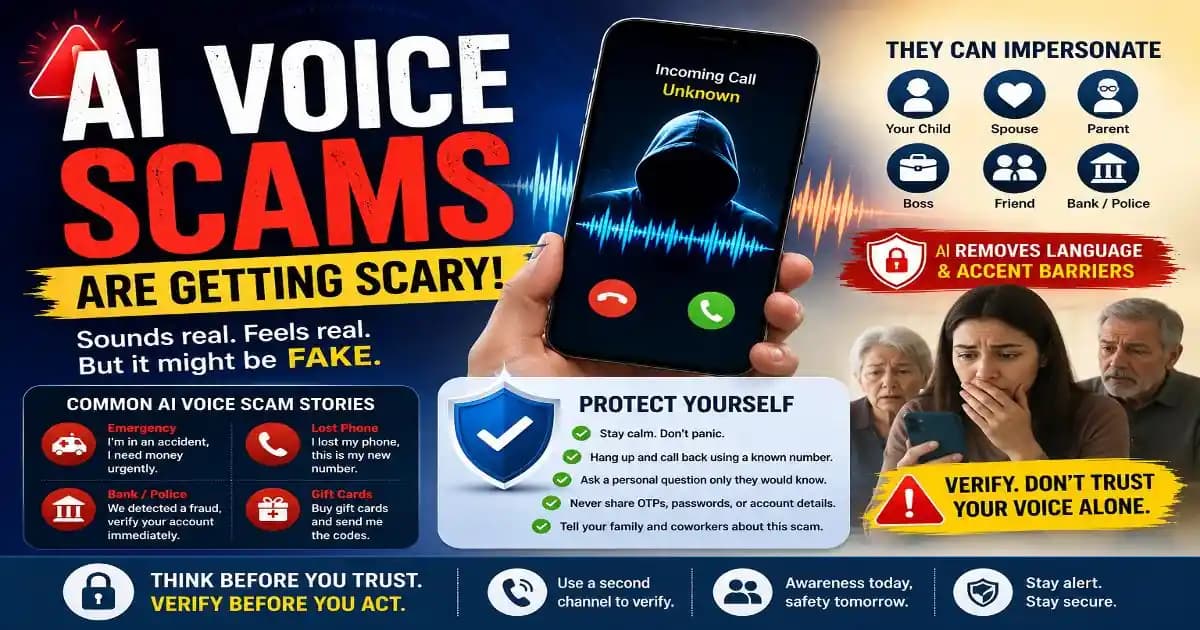
AI voice scams can turn a few seconds of someone's real speech into a convincing impersonation, creating a new problem for anyone who has learned to trust a familiar voice on the phone.
Imagine receiving a call from someone who sounds exactly like your child, partner, parent, manager, or close friend. The voice is familiar, the caller knows your name, and the situation sounds urgent. They may say they lost their phone, had an accident, need money immediately, or cannot access their normal account.
The instinctive reaction is often to help first and ask questions later.
That is exactly what makes voice-based impersonation effective. The technology does not have to create a perfect digital copy of a person for a scam to work. It only needs to sound convincing enough during a stressful conversation to make the victim stop verifying what they are hearing.
Understanding how these scams work changes the equation. The goal is not to become an expert at detecting synthetic audio. It is to build a verification habit that works even when the voice sounds completely real.
How AI Voice Scams Work
Modern voice-cloning systems can analyze recordings of a person's speech and generate new audio that resembles their voice. Depending on the system and the quality of the source material, a scammer may be able to imitate characteristics such as tone, pronunciation, rhythm, and speaking style.
That source material can potentially come from places people already use publicly. Social media videos, podcasts, interviews, livestreams, public presentations, and other recordings can provide samples of someone's voice.
The scammer then combines the generated voice with a familiar story.
That combination is more important than the technology itself. A fake voice saying “I need money” is not automatically convincing. A fake voice that also knows your relationship with the caller, uses their usual nickname, and creates a believable emergency can be much harder to question in the moment.
This is why AI voice cloning scams are fundamentally social-engineering attacks. The technology strengthens the impersonation, while the pressure and emotional manipulation do much of the rest.
Why a Familiar Voice Is No Longer Enough
For decades, hearing someone's voice over the phone was a useful informal form of identity verification. A family member's voice felt difficult to fake. A manager's voice sounded different from a stranger's. That assumption made telephone communication feel relatively personal.
Voice cloning weakens that assumption.
It does not mean every strange call is generated by AI, or that voice recognition has suddenly become useless. It means that a familiar voice should no longer be treated as the only proof of identity when the caller is requesting something sensitive.
The same principle applies to businesses. A voice that appears to belong to an executive or financial employee should not automatically be trusted when the caller requests an unusual payment, password, security code, account change, or confidential document.
Warning Signs of a Fake Voice Scam
The most useful warning signs are often behavioral rather than acoustic.
A caller who creates intense urgency deserves extra attention. Statements such as “Do this right now,” “Don't tell anyone,” or “I cannot explain because I am in trouble” are designed to reduce the time available for independent verification.
Another warning sign is an unusual payment request. Criminals may ask victims to send money through cryptocurrency, gift cards, bank transfers, payment applications, or other methods that are difficult to reverse.
Requests for passwords, one-time codes, banking information, identity documents, or remote access should also trigger caution. A familiar voice does not make those requests safe.
There can be acoustic clues too. Synthetic speech may sometimes contain unusual pauses, strange pronunciation, inconsistent emotion, unnatural transitions, or an odd response to an unexpected question. But these clues are not reliable enough to form the main defense. Voice-generation systems are improving, and call quality itself can distort natural speech.
The Best Defense Is a Second Channel
If a caller claims to be a family member in an emergency, do not use the same conversation to prove their identity.
Instead, create an independent verification path.
Hang up and call the person using a phone number you already have saved. If they normally communicate through a messaging application, contact them there. If the caller claims to be a coworker, contact that person through your company's normal communication system.
The key is independence. Do not use a number or link supplied by the suspicious caller because the attacker controls that information.
Families can make this easier by establishing a Simple verification phrase or private question for unusual emergency requests. It should not be something publicly visible on social media.
This approach is powerful because it does not require you to determine whether the voice itself is artificial. Even a technically excellent clone becomes much less useful when the victim independently confirms the situation.
What to Do If the Caller Claims to Be a Family Member
Family-emergency scams are particularly effective because they target emotion rather than technical knowledge.
If someone calls claiming to be your child, parent, spouse, or another relative and asks for immediate help, slow the conversation down.
Ask a question that a stranger using publicly available information would have difficulty answering. More importantly, independently contact the real person or another trusted family member.
Do not let the caller prevent you from checking. Statements such as “my phone is dying,” “don't call anyone,” or “you only have five minutes” should increase your willingness to verify rather than reduce it.
If money is involved, pause the transaction completely until the identity and situation are confirmed.
AI Phone Scams Can Target Businesses Too
The risk is not limited to personal calls.
A criminal may imitate an executive, supplier, employee, customer, or technical support representative. The objective could be a fraudulent payment, unauthorized account change, disclosure of confidential information, or access to an internal system.
Businesses can reduce this risk by separating voice communication from authorization. A phone call should not be enough to approve an unusual financial transfer or change sensitive account information.
Organizations can establish confirmation procedures for high-risk requests, such as requiring a second employee to verify payment details through an existing business channel.
This is an important security principle: authentication should become stronger as the potential impact of the action increases.
Can You Detect AI-Generated Voices?
There are technologies designed to analyze audio for signs of synthetic generation, but ordinary users should not depend on an AI detector during a live scam call.
Detection systems can produce mistakes, and attackers can change their techniques. Audio quality, compression, background noise, telephone networks, and recording conditions can also make analysis difficult.
Human verification through a separate communication channel is often simpler and more dependable.
Think of the voice as one piece of information rather than proof of identity.
What to Do If You Already Responded to an AI Voice Scam
If you sent money, disclosed a password, shared a security code, or provided sensitive personal information, act quickly rather than waiting to see what happens.
Contact the relevant bank or payment provider through its official contact method. Change compromised passwords from a trusted device and enable stronger authentication where available. If an account may have been accessed, review recent activity and terminate unfamiliar sessions.
If you disclosed information that could be used for identity fraud, monitor affected accounts and follow the appropriate reporting or recovery process in your region.
Do not continue communicating with the suspected scammer simply to collect evidence. Preserve relevant messages or call details if needed, but prioritize securing accounts and financial assets.
AI Voice Scams Change the Meaning of “Trust the Voice”
The most important lesson from AI voice scams is not that every phone call should be feared. It is that familiarity and authenticity are no longer the same thing.
A convincing voice can be generated. A caller can know personal details. A conversation can sound natural. None of those signals should override basic verification when money, credentials, account access, or sensitive information is involved.
The safest habit is surprisingly simple: pause, hang up when appropriate, and verify through a communication channel you control.
That small delay removes much of the attacker's advantage. Technology may make impersonation easier, but it does not have to make verification harder.