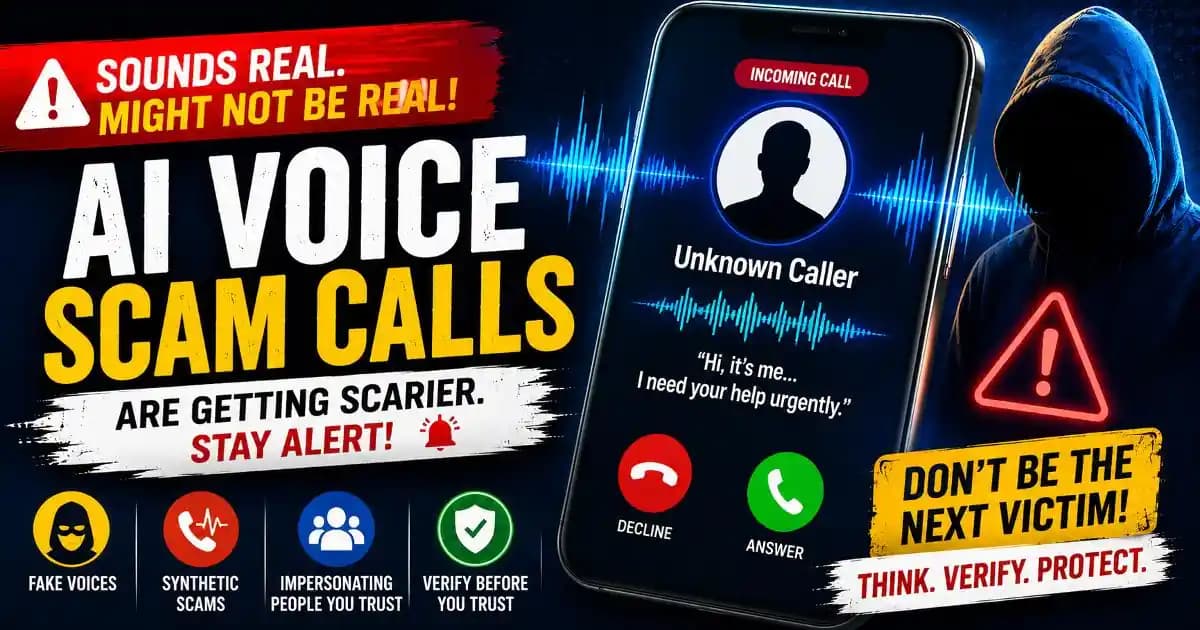
AI voice scam calls are becoming increasingly difficult to recognize as synthetic voice systems grow more realistic and emotionally convincing during 2026. A person answers the phone and hears what sounds like a family member asking for urgent help, a bank representative warning about suspicious activity, or a coworker requesting verification details. The voice sounds familiar. The tone feels natural. Sometimes even the breathing patterns and conversational pauses feel authentic.
That realism is what makes modern voice scams different from older robocall fraud.
Earlier scam calls often relied on obvious Warning signs like robotic speech, broken language, or aggressive pressure tactics. Today’s AI-assisted scams increasingly imitate normal human communication patterns. Attackers no longer need to sound obviously fake. In many cases, they only need to sound believable for a few minutes.
The shift reflects a larger transformation happening across digital ecosystems where synthetic media tools became more Accessible, faster, and easier to deploy at scale.
Voice generation technology itself is not inherently malicious. Many legitimate systems now use synthetic voices for accessibility tools, translation systems, content production, customer service automation, and productivity workflows. But the same advancements improving digital experiences also created new opportunities for Impersonation-based fraud.
For ordinary users, the challenge is psychological as much as technical. Human beings naturally trust familiar voices.
Why AI Voice Scam Calls Feel More Personal Than Older Fraud
Voice carries emotional weight differently than text Messages or emails.
A Suspicious email can be ignored. A strange SMS can feel distant. But hearing a familiar-sounding voice triggers immediate emotional processing.
That reaction becomes especially powerful during moments involving:
- Family emergencies
- Financial panic
- Workplace pressure
- Account security warnings
- Medical concerns
- Urgent verification requests
Modern scam operations increasingly understand that emotional familiarity creates faster trust than visual branding alone.
Some attacks now use AI-generated voices to imitate:
- Family members
- Managers or coworkers
- Bank representatives
- Government officials
- Customer support agents
- Public figures
In many situations, the goal is not perfect voice cloning. It is simply creating enough emotional plausibility to lower skepticism temporarily.
A stressed person reacting quickly may not stop to analyze whether every vocal detail sounds authentic.
How AI Voice Cloning Became More Accessible
Voice synthesis technology advanced rapidly because demand expanded across legitimate industries.
Modern systems now support:
- Podcast editing
- Video localization
- Voice assistants
- Accessibility tools
- Language translation
- Digital avatars
- Customer service automation
As these tools improved, the technical barrier for generating realistic voices dropped significantly.
Earlier voice cloning often required large datasets and specialized expertise. During 2025 and 2026, some platforms became capable of producing convincing voice samples from very limited audio input.
That Matters because people constantly publish audio Online now.
Voice samples appear through:
- Social media videos
- Voice notes
- Podcasts
- Interviews
- Video calls
- Streaming platforms
- Workplace presentations
The modern internet contains enormous amounts of publicly Accessible speech data.
Most users never imagined casual online audio could eventually support impersonation systems.
Why Banks and Customer Support Systems Became Prime Targets
Financial institutions and support ecosystems increasingly rely on phone-based Verification workflows.
Users already expect calls involving:
- Fraud alerts
- Account verification
- Transaction confirmation
- Password resets
- SIM card issues
- Subscription problems
This normalization created ideal conditions for AI-enhanced impersonation scams.
A synthetic voice pretending to represent a bank may sound calm, procedural, and technically informed. The scam no longer depends on dramatic threats Immediately. Instead, it mirrors legitimate customer support behavior.
Some attacks combine voice calls with phishing websites, fake SMS alerts, or spoofed caller ID systems to create layered credibility.
The experience feels operationally real.
This reflects a broader trend where modern scams increasingly imitate ordinary digital workflows rather than relying only on panic tactics.
How Remote Work Changed Voice-Based Fraud
Remote and hybrid work environments quietly expanded the attack surface for voice scams.
Employees now regularly receive calls involving:
- Cloud account verification
- VPN troubleshooting
- Collaboration platform access
- IT support workflows
- Project coordination
- Authentication requests
That communication environment already depends heavily on digital trust.
An employee hearing what sounds like a manager Requesting Urgent action may respond quickly without fully Verifying the source, especially during busy workdays involving constant calls and notifications.
Some Security researchers increasingly warn that synthetic voice systems could become especially Dangerous inside distributed workplaces where people interact remotely more often than face-to-face.
The less frequently users hear someone in person, the harder subtle voice inconsistencies become to detect.
Why Emotional Urgency Remains Central to Voice Scams
Even as technology changes, the psychology Behind scams remains remarkably consistent.
Most AI voice scams still rely on emotional acceleration.
Common narratives include:
- A family member was arrested
- A child needs emergency money
- A bank account was compromised
- A work account faces suspension
- A payment must be verified immediately
The synthetic voice simply amplifies the emotional realism.
Hearing a familiar voice during an urgent situation can override rational analysis temporarily. That emotional reaction is precisely what attackers exploit.
Some scams intentionally create chaotic environments where victims feel pressured to act Before independently verifying the situation.
The technology changed, but the manipulation model still depends heavily on urgency, confusion, and trust engineering.
How Caller ID Spoofing Makes AI Voice Scams Worse
Many users still assume a recognizable caller ID means the call is legitimate.
Unfortunately, spoofing systems allow attackers in some regions to imitate trusted numbers relatively easily.
A call may appear connected to:
- A local bank
- A telecom provider
- A government office
- A workplace contact
- A family member
Combined with AI-generated voices, spoofed caller identity creates a much more convincing environment than older robocall scams.
Users naturally rely on layered trust signals:
- The number looks familiar
- The voice sounds believable
- The request feels plausible
That combination lowers skepticism quickly.
Modern digital fraud increasingly succeeds not because one deception is perfect, but because multiple believable signals work together simultaneously.
Why Small Audio Samples Can Become a Privacy Risk
Many users underestimate how much voice data they already share publicly.
Short recordings posted online may eventually support synthetic voice generation systems capable of imitating tone, cadence, and speech patterns.
Public voice exposure now happens constantly through:
- Social media clips
- Video content
- Online meetings
- Streaming sessions
- Voice messages
- Interviews
This does not mean users Should panic or avoid publishing content entirely. But it reflects how digital identity now extends beyond passwords and photos into biometric-style communication patterns.
Voice itself increasingly functions as a trust signal online.
That makes synthetic voice manipulation more Socially powerful than ordinary spam calls.
How AI Voice Scams Are Affecting Families
One particularly unsettling trend involves scams targeting parents and relatives using fake emergency calls.
Attackers may claim:
- A child was injured
- A family member lost their phone
- An arrest occurred
- Emergency money is needed immediately
The voice only needs to sound emotionally familiar for a brief moment to create panic.
Some victims later describe acting instinctively before critically evaluating whether the situation made sense.
This highlights an important reality of modern fraud: emotional timing matters more than technical perfection.
The scam succeeds when urgency interrupts verification behavior.
Why Verification Habits Matter More Now
As synthetic communication systems improve, digital trust increasingly depends on independent verification rather than surface familiarity alone.
Users may need to normalize behaviors such as:
- Calling back independently
- Using trusted contact methods
- Confirming requests through separate channels
- Pausing before transferring money
- Questioning urgent emotional pressure
Many cybersecurity professionals now encourage families and workplaces to establish verification habits for sensitive requests, especially those involving money, credentials, or emergency action.
The broader challenge is cultural.
Modern communication systems increasingly prioritize speed and immediacy, while security depends on slowing down long enough to verify context.
How Technology Companies Are Responding
Major technology platforms are increasingly discussing synthetic media safeguards, watermarking systems, authentication tools, and fraud detection models.
Voice platforms, Mobile operating systems, telecom providers, and cloud communication services all face growing pressure to improve scam detection.
At the same time, the technology evolves rapidly.
The same AI ecosystems supporting accessibility, language translation, and creative production also support increasingly realistic impersonation systems.
This creates a difficult balance between innovation and misuse prevention.
Unlike older malware threats, synthetic voice fraud often exploits human trust more than technical vulnerabilities directly.
That makes platform-level protection harder.
Why AI Voice Scam Calls Reflect a Bigger Digital Shift
The rise of AI voice scam calls reflects a broader transformation happening across modern digital life.
Communication itself is becoming synthetic, automated, personalized, and increasingly difficult to authenticate intuitively.
People already interact daily with:
- AI-generated customer support
- Synthetic narration systems
- Voice assistants
- Automated scheduling tools
- AI-driven communication platforms
As these systems become normalized, distinguishing between authentic and generated communication may become psychologically harder for ordinary users.
The future challenge is not only technical detection. It is preserving trust inside communication systems where realism no longer guarantees authenticity.
For many people, the unsettling part of AI voice scams is not simply that the technology exists. It is realizing how naturally human beings respond to familiar voices, even in environments where those voices can now be artificially recreated.
Sometimes the most convincing scam is not the loudest or most aggressive. It is the one that sounds calm, familiar, and emotionally real for just long enough to bypass doubt.