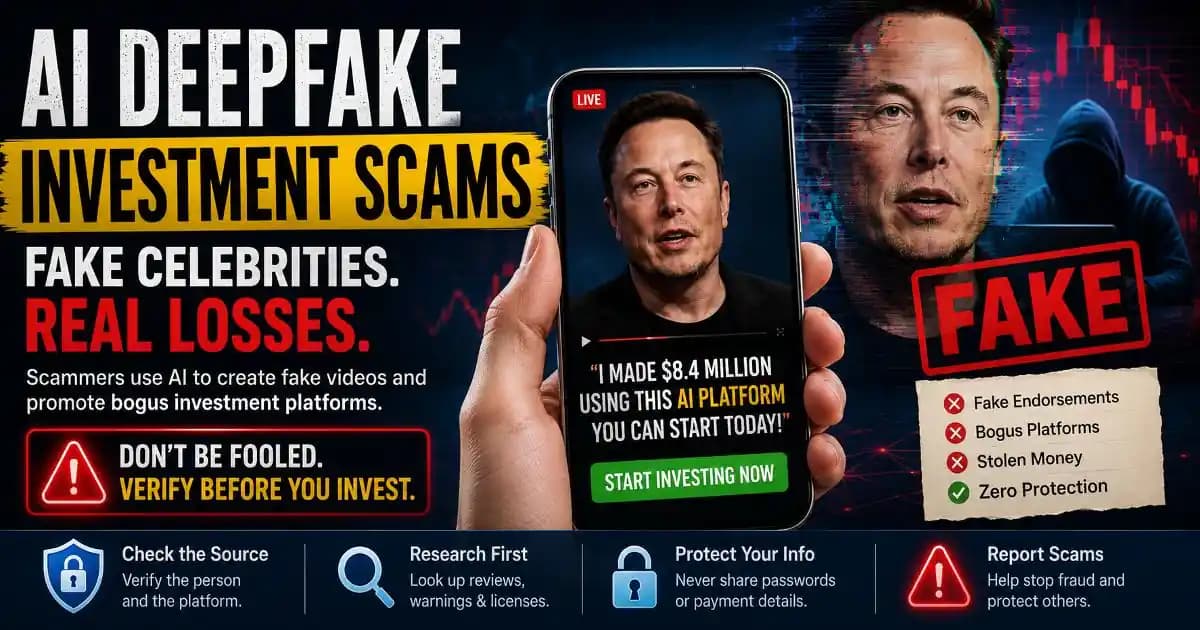
AI deepfake investment scams can turn a familiar celebrity, politician, financial expert or business leader into the face of a completely fake investment opportunity.
You might be scrolling through social media when a video appears to show a famous person explaining how they made money through an AI trading platform. The video looks polished. The voice sounds convincing. A news-style headline appears underneath it, followed by a link promising access to the same investment opportunity.
For someone already interested in cryptocurrency, trading or passive income, the story can feel unusually credible.
That credibility is exactly what the scammer is buying with artificial intelligence.
Authorities have repeatedly warned about fake celebrity videos and news articles promoting fraudulent investment platforms. Australia's Scamwatch describes deepfakes as lifelike impersonations created with AI and warns that scammers use them to make fake investment platforms appear legitimate. ([Scamwatch][1])
How AI Deepfake Investment Scams Work
The technology is only one part of the fraud. The deeper trick is the combination of impersonation, social engineering and a fake financial product.
The scam often starts with an advertisement or video on a social platform. The content may show a celebrity apparently discussing an investment strategy, an AI trading bot, cryptocurrency or a new financial platform.
The video then directs viewers toward a website that looks like a professional investment service. It may contain charts, account balances, customer dashboards and claims about artificial intelligence automatically identifying profitable trades.
After submitting contact information, the victim may receive a phone call or Message from someone pretending to be an investment adviser or account manager. The conversation makes the opportunity feel even more legitimate.
Scamwatch has documented a pattern where victims are encouraged to make a relatively small initial payment before being persuaded to deposit more money. Fake dashboards can then display supposed profits, creating the impression that the investment is working. When the victim tries to withdraw funds, scammers may demand additional fees or taxes. ([Scamwatch][1])
Why a Celebrity Deepfake Can Feel More Trustworthy Than an Advertisement
People naturally use familiarity as a shortcut when evaluating information.
If a video appears to show a person you recognize, your brain may spend less time questioning the basic premise. The scammer does not need to convince you that an unknown investment company is trustworthy from scratch. Instead, they borrow the reputation of someone you already know.
This is particularly effective when the fake endorsement is presented as part of a news interview or television segment.
The scammer can combine a deepfake video with a copied logo, fake article, fabricated comments, realistic financial charts and a professional-looking website. Each individual element reinforces the others.
ASIC has specifically warned about fake news articles and AI-generated celebrity endorsements used to promote fraudulent Online investment platforms. In 2026, ASIC also highlighted suspected AI-powered investment scam advertisements featuring fake celebrity endorsements and claims about AI trading systems. ([ASIC][2])
The “AI Trading Bot” Claim Deserves Extra Attention
Many of these scams do not simply promise investment returns. They claim that artificial intelligence is responsible for generating those returns.
The pitch may say that an AI system can analyze thousands of markets, predict price movements or automatically trade cryptocurrency while you earn passive income.
AI itself is real, of course. The problem is that scammers can use the word “AI” as a credibility shortcut.
A sophisticated-looking dashboard does not prove that an automated trading system exists. A chart showing your balance increasing does not prove that money is actually invested. And a claim that a trading bot produces guaranteed or unusually high returns should be treated as a serious warning sign.
ASIC has warned about scammers falsely claiming that AI trading bots generate passive income and unachievable returns. ([ASIC][2])
Fake Celebrity Crypto Scams Follow a Familiar Pattern
A fake celebrity crypto scam often follows a predictable sequence.
First, the victim sees a celebrity endorsement. Then comes the promise that the celebrity discovered an advanced investment system. A link leads to a registration form where the victim provides contact information.
The next stage often moves away from the public advertisement and into a private conversation.
A supposed investment representative may call or message the victim, explain how the platform works and encourage an initial deposit. Once the victim sees a rising balance on the fake dashboard, the scammer has created a powerful psychological effect: the victim believes the money is already making money.
The scam can become much more expensive when the victim attempts to withdraw the supposed profits. Additional charges may suddenly appear. The scammer may describe them as taxes, processing fees, verification costs or account-release charges.
These demands are not evidence that the investment is legitimate. They can simply be another stage of the fraud.
How to Tell If a Celebrity Investment Video Is Fake
Do not rely on whether the person's face or voice looks convincing. Deepfake quality can change rapidly, and visual inspection alone is not a reliable verification method.
Instead, investigate the investment claim itself.
Ask whether the celebrity has actually promoted the product through a verified official account or their known public channels. Search for independent confirmation rather than clicking the advertisement's link.
Look at the website address carefully. A page that copies the appearance of a news organization does not mean it belongs to that organization. Likewise, a celebrity photograph on an investment website does not establish a genuine relationship with the person.
ASIC recommends checking whether the associated financial services provider is properly licensed and whether it appears on relevant investor alert resources. ([ASIC][3])
Five Warning Signs That Should Make You Stop
- Guaranteed or unusually high returns: legitimate investments involve risk, and certainty about extraordinary profits is a major warning sign.
- A celebrity suddenly promoting a little-known platform: verify the endorsement independently through the person's established channels.
- Pressure to deposit quickly: urgency is often used to prevent careful research.
- A dashboard showing effortless profits: an attractive interface is not proof that real trades or assets exist.
- Unexpected withdrawal fees: demands for additional money before releasing supposed profits can indicate an investment scam.
Why Fake Investment Platforms Look So Professional
Scammers no longer need to build obviously amateur websites.
Modern website templates, copied branding, live-looking charts, automated chatbots and convincing account dashboards can make a fraudulent platform appear sophisticated. ASIC reported that scammers have been using polished website templates, third-party content and chatbots to make fake investment platforms appear more credible. ([ASIC][4])
This creates an important lesson for digital users: design quality is not the same as legitimacy.
A professional interface can be created for a fraudulent service just as easily as for a legitimate one.
What to Do If You Already Sent Money
If you believe you have interacted with an AI investment scam, stop communicating with the supposed investment representative and do not send additional money to “recover” your funds.
Contact your bank, card provider or cryptocurrency service through an official channel and explain what happened. Save screenshots, transaction records, wallet addresses, messages, phone numbers and website addresses because these details may be useful when reporting the incident.
Be especially careful if someone later contacts you claiming they can recover your money for an upfront fee. Victims of investment scams can become targets for secondary recovery scams.
If you shared passwords or other account credentials, secure those accounts from a trusted device and enable stronger authentication where available.
AI Makes the Scam More Convincing, Not the Investment More Real
The central mistake in an AI deepfake investment scam is allowing the technology used in the advertisement to become evidence that the investment itself is legitimate.
A convincing video does not prove that a celebrity endorsed something. A sophisticated dashboard does not prove that money is being traded. An AI label does not prove that a profitable trading system exists.
The safest response is to separate the presentation from the financial claim.
Verify the person. Verify the company. Verify the license or authorization where applicable. Verify the investment independently. And never let a countdown timer, celebrity endorsement or promise of easy profits replace basic research.
AI can make a fake person look real, but it cannot turn a fraudulent investment platform into a legitimate one.