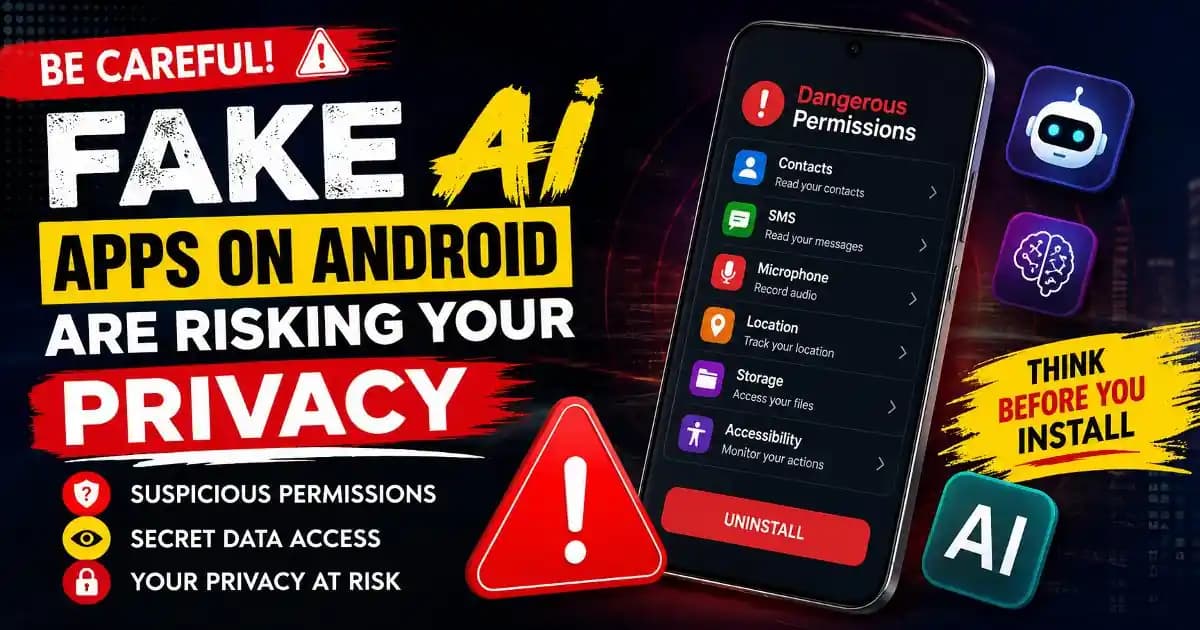
fake AI apps Android users are downloading for image editing, chatbots, writing assistance, and productivity are becoming one of the fastest-growing privacy concerns inside the mobile ecosystem.
Over the past year, Android users have started seeing an explosion of apps promising AI wallpapers, AI companions, AI keyboard upgrades, AI video generators, AI voice cloning, AI writing tools, and AI photo enhancers. Many of these apps look polished enough to appear legitimate at first glance. Their screenshots resemble premium software. Their descriptions are filled with familiar AI language. Some even imitate the design style of popular tools from OpenAI, Google, Microsoft, or Adobe.
But behind the branding, some of these applications are requesting permissions that have little connection to the features they claim to provide.
An AI wallpaper app asking for contact access. A chatbot requesting microphone permissions permanently. A photo enhancer trying to read SMS messages. A fake AI keyboard monitoring accessibility services. These patterns are increasingly drawing attention from cybersecurity researchers, Android analysts, and privacy-focused users.
Why fake AI apps Android users install are becoming difficult to identify
The modern Android ecosystem moves faster than most users can realistically track. AI hype accelerated this problem during 2025 and 2026 because developers realized that adding the phrase “AI-powered” dramatically improves visibility in app stores, advertisements, and social media recommendations.
For users, AI now feels attached to almost every digital activity:
- photo editing
- document summarization
- voice transcription
- translation
- note-taking
- coding assistance
- social media content creation
- productivity automation
That demand created a massive opportunity for legitimate software companies. But it also created an opening for deceptive developers looking to exploit user curiosity.
Unlike older malware campaigns that relied on obvious scams or suspicious APK downloads, many fake AI apps now appear directly inside mainstream app marketplaces. Some survive by using aggressive advertising rather than technically malicious behavior. Others quietly collect excessive data while staying just below platform enforcement thresholds.
This makes detection harder for average users because the danger is not always obvious ransomware or device takeover behavior. Sometimes the real issue is long-term data exposure.
An app may function partially as advertised while simultaneously collecting analytics, monitoring usage habits, harvesting identifiers, or requesting permissions that expand surveillance capabilities beyond what users expect.
The permission requests are often the first warning sign
Android permissions have always been a balancing act between functionality and privacy. Navigation apps need location access. Camera apps require storage permissions. Messaging apps need contacts and notifications.
AI applications complicate this further because machine learning features often depend on broader data access. Voice assistants need microphone permissions. AI image editors may need gallery access. Productivity tools might require file access for summarization features.
That overlap creates ambiguity attackers can exploit.
Some suspicious AI apps intentionally over-request permissions because users now assume AI systems need extensive access to operate effectively.
In practice, many fake or low-trust AI apps request access to:
- contacts
- call logs
- SMS messages
- accessibility services
- persistent microphone access
- background clipboard monitoring
- device usage statistics
- notification reading permissions
Accessibility permissions are particularly sensitive. On Android, accessibility services were originally designed to help users with disabilities interact with devices more effectively. But malicious apps increasingly abuse these permissions because they can observe screen content, monitor interactions, and sometimes perform actions automatically.
Cybersecurity researchers have repeatedly observed malware families using accessibility permissions to intercept banking credentials, approve transactions, or manipulate user interfaces invisibly.
When a simple AI wallpaper generator requests accessibility access, users should pause immediately.
Some apps imitate real AI ecosystems intentionally
The AI boom created strong brand recognition around companies like Google Gemini, ChatGPT, Microsoft Copilot, Claude, and various image-generation platforms. Fake AI apps increasingly mimic the visual language of these ecosystems.
Developers sometimes use:
- similar icons
- similar names
- AI-themed screenshots
- familiar chatbot layouts
- keyword-heavy descriptions
- fake review patterns
This imitation strategy works because users associate AI interfaces with conversational simplicity. A clean chatbot layout immediately feels trustworthy to many people, especially when paired with promises like:
- “GPT-powered assistant”
- “Unlimited AI tools”
- “Advanced AI photo enhancer”
- “AI security scanner”
- “Private AI chat experience”
In some cases, the apps simply wrap publicly available AI APIs inside aggressive advertising systems. In more concerning situations, the apps collect data while delivering minimal real AI functionality.
Users often discover the problem only after noticing unusual battery drain, excessive ads, subscription traps, unexplained permissions, or suspicious background activity.
AI hype changed how users evaluate software trust
One of the biggest behavioral shifts happening during 2025 and 2026 is that users increasingly prioritize features over trust evaluation.
People want quick results:
- instant avatars
- AI-generated resumes
- voice cloning
- viral video editing
- automated captions
- AI study tools
That urgency reduces caution.
Historically, users were more skeptical of apps asking for broad permissions. But AI systems changed expectations because many people now assume advanced tools naturally require extensive device access.
This creates a dangerous psychological effect where suspicious behavior feels temporarily justified.
An app requesting microphone access no longer feels unusual if users believe it powers speech AI. Camera permissions feel normal for AI enhancement tools. File access feels expected for AI summarizers.
The problem emerges when those permissions are disconnected from the actual product behavior.
Android security systems are improving, but the ecosystem remains complex
Google continues expanding Android security protections through Play Protect, permission controls, sandboxing improvements, background activity restrictions, and app review systems. Modern Android versions also give users more visibility into microphone, location, and camera usage.
But Android remains a highly open ecosystem compared to some competing mobile platforms. That openness supports innovation, customization, sideloading, and broader developer participation. It also creates a larger attack surface.
Some fake AI apps avoid detection by:
- changing package names frequently
- releasing cloned variants
- using delayed malicious behavior
- embedding aggressive SDKs
- hiding suspicious features behind updates
- operating through short-lived publisher accounts
AI trends accelerate these cycles because app categories evolve faster than traditional review systems can always react.
Generative AI also lowers barriers for attackers themselves. App descriptions, fake reviews, phishing messages, promotional images, and even cloned interfaces can now be generated rapidly at scale.
The privacy risks go beyond obvious malware
Not every suspicious AI app is outright malware. In many cases, the larger concern is excessive data collection combined with unclear transparency.
Some apps monetize through:
- behavioral profiling
- advertising identifiers
- third-party analytics sharing
- cross-app tracking
- cloud-based data retention
- subscription manipulation
Users frequently underestimate how much personal context modern smartphones contain. AI-related apps may gain access to:
- voice samples
- photos
- documents
- clipboard contents
- calendar data
- device identifiers
- usage patterns
- notification previews
Even when individual data points appear harmless, aggregated behavioral information can become extremely valuable.
This is especially relevant as AI systems increasingly rely on personalization. Some applications continuously gather interaction data to improve recommendation systems, training pipelines, or targeted advertising models.
Users are becoming more aware of app behavior patterns
One positive shift is that mobile users are gradually becoming more privacy-conscious. Permission dashboards, cybersecurity creators, Android transparency tools, and digital safety education are helping people recognize suspicious app behavior earlier.
More users now check:
- developer history
- privacy policies
- permission requests
- update frequency
- review authenticity
- background activity indicators
There is also growing awareness that “free AI tools” often operate through hidden tradeoffs. If an app offers expensive-looking AI capabilities without clear monetization, users are increasingly asking how the infrastructure is funded.
That question matters because real AI processing requires computing resources, cloud infrastructure, and ongoing operational costs.
When transparency is missing, the business model may depend heavily on aggressive data extraction or advertising ecosystems.
What safer AI app behavior usually looks like
Legitimate AI-focused Android apps typically explain permissions clearly and connect them directly to visible functionality.
For example:
- a transcription app explains microphone usage
- a photo editor requests gallery access only when needed
- a chatbot limits background permissions
- a productivity assistant clarifies cloud syncing behavior
Trusted apps also tend to provide:
- clear privacy documentation
- transparent subscription terms
- active developer support
- consistent update history
- public company information
- manageable permission controls
By contrast, suspicious apps often rely on vague AI claims, aggressive popups, excessive permissions, cloned branding, and poor transparency around data handling.
The AI app explosion is reshaping mobile security itself
The broader issue extends beyond a few fake applications. AI is fundamentally changing how mobile software is designed, marketed, and trusted.
Users are now interacting with apps that process language, images, voice, biometrics, and behavioral patterns continuously. That means privacy conversations are no longer limited to traditional malware or spyware.
The future of mobile security increasingly involves understanding how AI systems access data, where processing occurs, what gets stored in the cloud, and how personal information contributes to broader machine learning ecosystems.
As AI features become embedded into everyday Android experiences, the difference between legitimate innovation and exploitative behavior may become harder to distinguish for ordinary users.
That is why the current wave of fake AI apps matters beyond individual scams. It reflects a deeper transition happening across software ecosystems where trust, convenience, automation, and data collection are becoming tightly interconnected.
For Android users, privacy awareness is no longer just about avoiding obviously dangerous apps. It is increasingly about understanding how modern AI software behaves behind the interface.