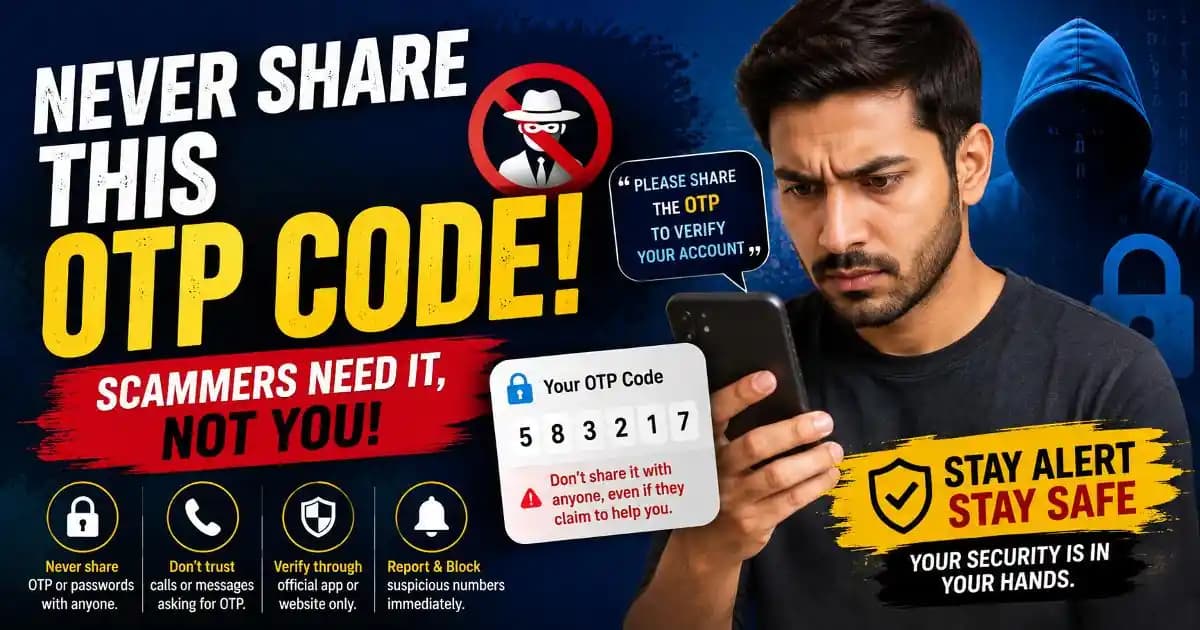
Never share this OTP code is a simple rule that can prevent a surprisingly complicated account takeover. An unexpected verification code arrives on your phone, followed seconds later by a call from someone claiming to be from your bank, mobile provider, delivery company, workplace, or another familiar service. They sound confident and may already know some basic information about you. Then comes the request: read the code back to them.
The code itself is not usually the scam. It is the final piece of a process that may have started somewhere else. Understanding that distinction makes OTP scams much easier to recognize.
Never Share This OTP Code When Someone Requests It
An OTP, or one-time password, is designed to prove that the person attempting an action has access to a particular device, phone number, email account, or authentication method. Depending on the service, it may be used when signing in, resetting a password, adding a new device, approving a transaction, or confirming a sensitive change.
That is why scammers value these codes. They do not necessarily need to steal the code directly from your phone. Instead, they can manipulate you into handing it over.
A common pattern begins when a criminal starts a legitimate-looking login or account recovery process using your phone number or email address. The service sends a real OTP to you. The scammer then contacts you and creates a reason for asking about it.
They might claim that the code was sent by mistake, that your account is under review, or that they need to verify your identity. The message may sound routine because the OTP really did come from the legitimate service.
This is an important detail: a genuine verification code can still be part of a fraudulent conversation.
Why OTP Scams Feel Convincing
Modern scams increasingly rely on social engineering rather than obvious technical tricks. The attacker is trying to influence your decision at the exact moment when you are confused, distracted, or worried about losing access to an account.
Timing helps. If you receive an OTP immediately before someone calls you, the two events naturally appear connected. The scammer can use that coincidence to establish credibility.
Some criminals also use information gathered from public profiles, leaked databases, previous scams, or compromised accounts. Knowing your name, approximate location, workplace, or the service you use does not prove that the caller is legitimate.
Another problem is authority. People tend to respond differently when a caller claims to represent a bank, employer, government service, or technology company. The scammer may use formal language, background noise, scripted questions, or a sense of urgency to make the interaction feel official.
The Real Security Boundary
Think of an OTP as something intended for the service you are authenticating with, not for another person. A legitimate support representative may help you troubleshoot an account, but the safest approach is to enter authentication codes yourself through the official app or website rather than reading them aloud to an unexpected caller.
This principle applies beyond banking. Email accounts, social networks, messaging platforms, cloud services, shopping accounts, and developer platforms can all use additional verification.
What Happens After a Scammer Gets the Code?
The consequences depend on what the attacker was attempting to do. In one situation, the code may approve a login from a new device. In another, it could confirm a password reset or authorize an account change.
The attacker may then try to strengthen their access by changing recovery information, adding another authentication method, or creating a session that remains active. The exact behavior varies by platform, which is why the safest response is not to assume that one stolen OTP automatically means every account is lost.
If you accidentally disclose a code, act quickly. Open the service through its official app or manually entered website address rather than following a link provided by the caller. Review recent account activity, change your password if appropriate, check recovery settings, and contact the service through its official support channel.
Unexpected OTP Messages Deserve Attention
Not every unexpected OTP means someone is successfully attacking your account. A person may have entered the wrong phone number, or an automated system may have generated a code after a failed attempt. But an unexpected code becomes much more important when it is followed by a call, message, or email asking you to disclose it.
That combination should change how you respond. Instead of trying to determine whether the caller sounds genuine, stop the conversation and independently contact the organization.
This is also where account security becomes more than a password issue. Strong passwords, passkeys, authenticator apps, device security, recovery controls, and login alerts can work together to make unauthorized access harder.
OTP Scams Are Adapting to Modern Digital Habits
The broader lesson is that scams follow normal technology behavior. As more services move authentication into mobile apps and cloud platforms, criminals adapt their stories around those workflows.
A fake banking call may reference a transaction. A fake delivery message may create urgency around a package. A fake workplace request may appear during a busy remote-work day. The technical mechanism changes, but the psychological objective remains similar: make the victim act before thinking.
AI-assisted communication may also make fraudulent messages more polished, but users do not need to identify whether a message was written by a human or generated with software. The more useful skill is recognizing the underlying behavior: unexpected contact, pressure, requests for authentication information, and attempts to move you away from the normal account-recovery process.
For mobile users, this means developing a habit of separating incoming communication from authentication itself. A person calling you should not become the authority that controls how you authenticate.
What Good Digital Security Looks Like
Good security is often less dramatic than people expect. It is a collection of small decisions that reduce opportunities for attackers.
- Never read an OTP aloud to an unexpected caller or message sender.
- Do not approve a login or authentication request you did not initiate.
- Use official apps and websites when checking account activity.
- Enable stronger authentication methods when the service supports them.
- Review recovery email addresses, phone numbers, and trusted devices periodically.
- Treat urgent requests for passwords, OTPs, or authentication approvals as suspicious.
These habits also help with phishing and other forms of social engineering because they create a pause between receiving a request and acting on it.
The most useful security mindset is not assuming that every message is malicious. It is learning to verify important requests independently. A real company can still be impersonated, a real OTP can still be used in a scam, and a familiar-looking caller ID can still be misleading.
OTP technology remains useful because it adds another layer to authentication. But authentication only works as intended when the person receiving the code understands what the code represents. It is not a customer-service confirmation, a secret that support staff need to hear, or a number that should be forwarded to someone who calls unexpectedly.
When a verification code arrives and you did not initiate the action, the safest response is simple: pause, do not share it, and investigate through the official channel. That small habit can turn one of the most common scam tactics into a dead end.