
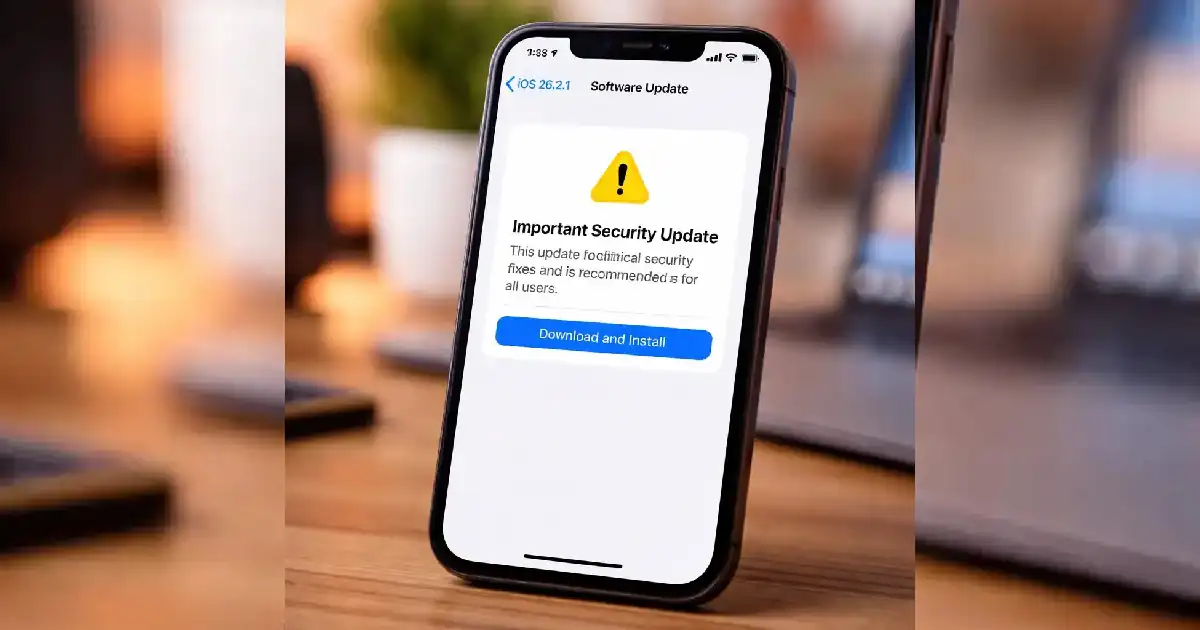
iOS 26.2.1 Update Security Alert: Install Immediately on iPhone
Why this small iPhone update carries outsized security importance
The iOS 26.2.1 update isn’t one of those flashy releases that tempt you with new emojis or redesigned icons. It arrives quietly, without much ceremony and that’s exactly what makes it dangerous to ignore. Beneath its modest size sits a set of security fixes aimed at vulnerabilities that attackers were already circling. For iPhone users, this update isn’t about convenience or curiosity. It’s about keeping the device in your pocket from becoming an open door.

Over the years, many people have developed Update fatigue. Another prompt, another restart, another five minutes lost. But some updates are different. This is one of them.
When “later” becomes a risk
Smartphones are no longer just phones. They’re wallets, photo albums, work terminals, health trackers, and keys to dozens of online accounts. A single Vulnerability in the operating system can ripple outward, exposing far more than a contact list or a few text messages.
The iOS 26.2.1 update addresses security flaws that affect how the system handles memory, permissions, and maliciously crafted content. In Simple terms, these are the kinds of weaknesses that can allow harmful code to run when it shouldn’t, or allow an app or website to step outside its sandbox.
Security researchers have become increasingly blunt about these types of issues. Once details of a vulnerability are knowneven partiallyattackers move fast. They don’t need to hack millions of phones. They just need enough unpatched ones to make the effort worthwhile.
That’s why delays matter. Even a week can be enough.
What makes this update different from routine patches
Not every security update carries the same weight. Some fix theoretical issues. Others fix bugs that have already been exploited in the wild. Apple rarely discloses full details immediately, and that silence often signals urgency rather than insignificance.
The fixes in iOS 26.2.1 focus on areas that attackers love to target:
- System-level memory handling, where a small flaw can cascade into full device compromise
- Web-based attack surfaces, which can be triggered simply by opening a malicious link
- App isolation boundaries, designed to keep one app from snooping on another
These aren’t obscure edge cases. They’re common entry points for spyware, surveillance tools, and credential-stealing malware.
If your phone handles sensitive work messages, banking apps, or personal photosand almost every phone doesthis update is directly relevant to you.

Why iPhone users are often targeted specifically
There’s a persistent myth that iPhones are immune to serious attacks. The reality is more nuanced. iOS has strong security foundations, but that strength also makes vulnerabilities more valuable when they do appear.
High-value targets include:
- Journalists and activists
- Business owners and executives
- Anyone using their phone for payments or authentication
But attackers don’t always pick victims individually. Automated exploits scan broadly, looking for devices that haven’t been updated yet. The moment your phone falls behind, it becomes easier to profile.
The iOS 26.2.1 update closes gaps that could otherwise be used silently. No pop-ups. No warnings. Just quiet data access happening in the background.
The hidden cost of skipping updates
Most people think the worst outcome of skipping an update is missing out on features. In reality, the cost is often invisible until it’s too late.
Unpatched phones can experience:
- Credential theft through malicious webpages
- Unauthorized access to private app data
- Background surveillance that drains battery and data without obvious signs
What makes this especially troubling is how normal everything can look. Your phone still works. Apps still open. Messages still arrive. Meanwhile, something else may be watching.
Security updates are less about fixing what’s broken and more about sealing what hasn’t failed yet.
How attackers take advantage of delay
There’s a pattern that repeats with almost every critical update. First, the patch is released. Then, security researchers analyze it. Shortly after, proof-of-concept exploits begin circulating privately. Finally, those techniques are weaponized.
The people most at risk are the ones who assume they have time.
Once an exploit exists, attackers don’t care why a device wasn’t updatedonly that it wasn’t. In that sense, procrastination becomes a vulnerability of its own.
The iOS 26.2.1 update alert sits squarely in this danger window, where fixes are known and unpatched devices are easiest to spot.

Why this matters beyond individual phones
Security isn’t just personal anymore. Compromised phones can become stepping stones into larger systems.
Think about:
- Work email accounts synced to your device
- Two-factor authentication codes delivered by SMS or app
- Shared cloud storage accessed automatically
A single vulnerable phone can expose an entire network of accounts. That’s why companies push updates aggressively, and why security teams often treat delayed patches as active threats.
Installing this update isn’t just self-protection. It’s digital hygiene.

The psychological trap of “nothing has happened yet”
Human nature works against good security habits. If nothing bad has happened so far, it feels safe to assume nothing will. But cybersecurity doesn’t work on hindsight. It works on probability.
Most people who experience breaches didn’t feel at risk the day before.
The uncomfortable truth is that the absence of problems doesn’t mean safetyit often just means opportunity hasn’t met timing. Updates like iOS 26.2.1 are about narrowing that window until it closes entirely.
What to expect after installing the update
Some users worry that security updates slow down their phones or introduce new bugs. In this case, the update is focused and lightweight. There are no major interface changes, no learning curve, and no app migrations.
Most people won’t notice anything differentand that’s the point.
The best security fix is one you never have to think about again.
If anything, users may notice improved stability in certain apps or fewer random glitches caused by low-level system issues.

Looking ahead: why updates are becoming more frequent
Operating systems are under constant pressure. As phones take on more rolespayments, identity verification, smart home controlthe incentive to exploit them grows.
This means:
- More frequent security patches
- Faster exploit development
- Shorter safe windows for outdated software
The iOS 26.2.1 update is part of that new reality. Waiting months between updates is no longer realistic. Security now moves in weeks, sometimes days.
Understanding that shift helps explain why urgency matters more than it used to.
A quiet action that makes a real difference
There’s nothing dramatic about tapping “Install Now.” No alarms. No headlines. Just a progress bar and a reboot.
But in terms of impact, few actions offer a better return on effort. Five minutes of updating can prevent monthsor yearsof fallout from a compromise you’d never see coming.
The iOS 26.2.1 update doesn’t ask for attention. It asks for trust. And in this case, that trust is well placed.

Frequently Asked Questions
Is the iOS 26.2.1 update really urgent?
Yes. It addresses security vulnerabilities that could be exploited if your device remains unpatched, even if everything appears normal.
Does this update add new features or change how my iPhone looks?
No. It’s a security-focused release with no major visual or functional changes.
Can skipping this update put my personal data at risk?
Potentially, yes. Unpatched vulnerabilities can allow unauthorized access to sensitive information stored or accessed on your phone.
Will installing it affect my battery life or performance?
Most users won’t notice any negative impact. In some cases, stability and performance may actually improve.
Do older iPhones need this update too?
If your device supports iOS 26.2.1, installing it is strongly recommended regardless of model age.
In a digital world where threats don’t announce themselves, staying protected often comes down to small, unglamorous decisions. Installing the iOS 26.2.1 update is one of those decisionsquiet, quick, and profoundly important.